
Vibe Coding
History
The term “Vibe Coding” was coined by Andrej Karpathy, a former OpenAI engineer, on Feb. 2, 2025 when he made the following post on X:
There’s a new kind of coding I call “vibe coding”, where you fully give in to the vibes, embrace exponentials, and forget that the code even exists. It’s possible because the LLMs (e.g. Cursor Composer w Sonnet) are getting too good. Also I just talk to Composer with SuperWhisper…
— Andrej Karpathy ((karpathy?)) February 2, 2025
The term went viral and has quickly become common parlance to describe using AI chatbots and agents to write code for you, often done using voice dictation which is faster than typing. On Novemmber 5, 2025, Collins Dictionary name vibe coding the Word of the Year. Vibe coding essentially treats English as a new coding language.
Despite, or perhaps because of it’s rapid impact, Vibe coding hasn’t been without controversy.
Skeptics argue that vibe coding encourages a shallow relationship with code where developers don’t fully understand the systems they’re building. They warn that overreliance on AI-generated code could erode problem-solving skills, introduce bugs, and obscure accountability when things go wrong. For them, coding is as much about thinking as typing; it’s a craft built on precision, discipline, and debugging, not vibes.
Supporters, on the other hand, view vibe coding as a the next step in a natural evolution of programming that has been going on for decades. Just as early compilers freed humans from low-level assembly code LLMs now free them from the need for typing every character of the detailed syntax required by modern programming languages. The essence of software creation, they argue, is translating intent into functionality and LLMs finally make it possible to do that directly in natural language. In this view, vibe coding doesn’t eliminate thinking but actually amplifies it by letting creators focus on design, logic, and impact rather than implementation details.
In practice, vibe coding has already begun reshaping workflows. Developers often “talk” to their editors using tools like Cursor via voice dication tools like SuperWhisper. The AI then drafts, refactors, and explains code in real time, blurring the boundary between writing and thinking about code.
Paul Graham, co-founder of the world’s most influential start-up incubator, Y-combinator (YC), seems to be coming around:
Vibe coding is here to stay. I’d been worried it might be a fad, but I talked to the founder of an infrastructure company who’s in a position to see how well vibe-coded apps are doing, and he said a lot of them are making money.
— Paul Graham ((paulg?)) August 15, 2025
A few month’s earlier in March of 2025, Jared Friedman, a YC managing partner shared in a conversation posted on YouTube that a quarter of the Winter 2025 batch of start-ups had 95% of their codebases generated by AI:
There are now a slew of new high-growth companies that have arisen that enable so called vibe coding which Dan Olsen has done a nice job of summarizing in the chart below:
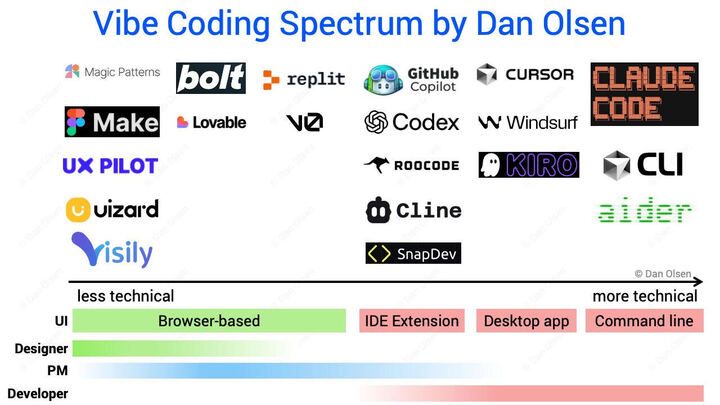
Dan’s workshop is focused on the left hand side of the chart, while my workshop focuses on the right hand side of the chart. It’s relatively easy and sometimes useful to mix and match tools from different sides of the chart.
One very clear high-value opportunity that vibe coding has enabled for Product Managers is the ability to rapidly prototype in a way that was previously impossible.
This is a massive opportunity if the common refrain at legendary Silicon Valley product design firm IDEO has any truth to it (spoiler, it does!):
“If a picture is worth 1000 words, a prototype is worth 1000 meetings.” —saying at (ideo?)
— John Maeda ((johnmaeda?)) October 5, 2014
Because of the speed, reduced costs in time and money, and the rapid customer discorvery it enables, the ability to build high-fidelity prototypes quickly using vibe coding tools is quickly becoming an expected skill of Product Managers:
We are adding a coding section to all of our Product Managers interviews at (Shopify?).
We’ll start with APM interviews. We expect candidates to build a prototype of the product they suggested in the case interview.
There is no excuse for PMs not building prototypes.— Kaz Nejatian ((CanadaKaz?)) August 13, 2025
Beyond prototyping, vibe coding with the developer focused tools we will use in this workshop (e.g. Claude Code) enable a whole host of other high value use cases for product manangers such as rapid data analysis, automations, and more effecicent and precise use of LLMs than is possible from standard chat interfaces like ChatGPT.
Looking ahead
Over the past two decades, many companies adopted a product trio team structure for building software products. This structure brings together three complementary roles: the product manager, who defines the vision, strategy, and priorities; the designer, who ensures usability, aesthetics, and a seamless user experience; and one or more engineers, who turn ideas into functional, scalable solutions. By balancing business objectives, user needs, and technical feasibility, the trio has emerged as a proven way to foster cross-functional collaboration and accelerate product development.
AI in general, and specific tools we will use in this workshop are having a major impact and may have the potential to disrupt what had become a stable organizational model since AI changes both the division of labor within the trio and the speed and scale at which individuals and teams can operate.
When a PM can quickly generate prototypes or even full-fledged shipable products without waiting on design or engineering support it could have a significant shift on when and how designers and engineers are engaged.
It remains to be seen how this will fully play out, but early indications suggest that shifts in how PMs, designers, and engineers work together are real and lasting.
The fight over what a product manager does is going to among the first major AI organizational design problems faced by companies.
— Ethan Mollick ((emollick?)) November 1, 2025
It is a job right at the center of what AI can do with first pass coding, marketing, design, ideation, etc. Who will own which pieces up for grabs. https://t.co/XkJQYOu9N9
With the right AI tools some ambitious individuals may be able to credibly wear all three hats and become what we could call a Full-Stack Product Builder.
Builder’s high is back…
— Madhu Guru ((realmadhuguru?)) August 13, 2025
That is the ambition we have for you by participating in this workshop. We hope this will be a catalyst for you in becoming a full-stack product builder who uses AI to build amazing products that improve humanity.
Indeed, we are living in the time when:
“Discoveries latent with such potent power, either for the blessing or the destruction of human beings as to make men’s responsibility in controlling them the most gigantic ever placed in human hands. … This age is fraught with limitless perils, as well as untold possibilities.” –David O. McKay, 1966
First Prototype
Let’s create our first prototype using both Lovable and Claude Code.
- Open a new terminal in VS Code and type
claudeto start up claude code. Paste in the following prompt and hit enter and answer Claude’s questions as it goes:
build me a simple to do list app with json data storage that I can deploy locally. - While waiting for Claude, open Lovable in a web browser and paste in the same prompt and hit enter.
Congratulations, you have vibe coded your first prototype!
However, we can do a lot better than this and soon will.
Terminology
Despite its popularity, I really don’t like the term “vibe coding” because it sounds unserious, and frankly, much of the time it is which explains why we see an explosion of engineers branding themselves as “Vibe Code Cleanup Specialists.” These people are hired to clean-up so called AI slop which is AI generated code or content generated carlessly.
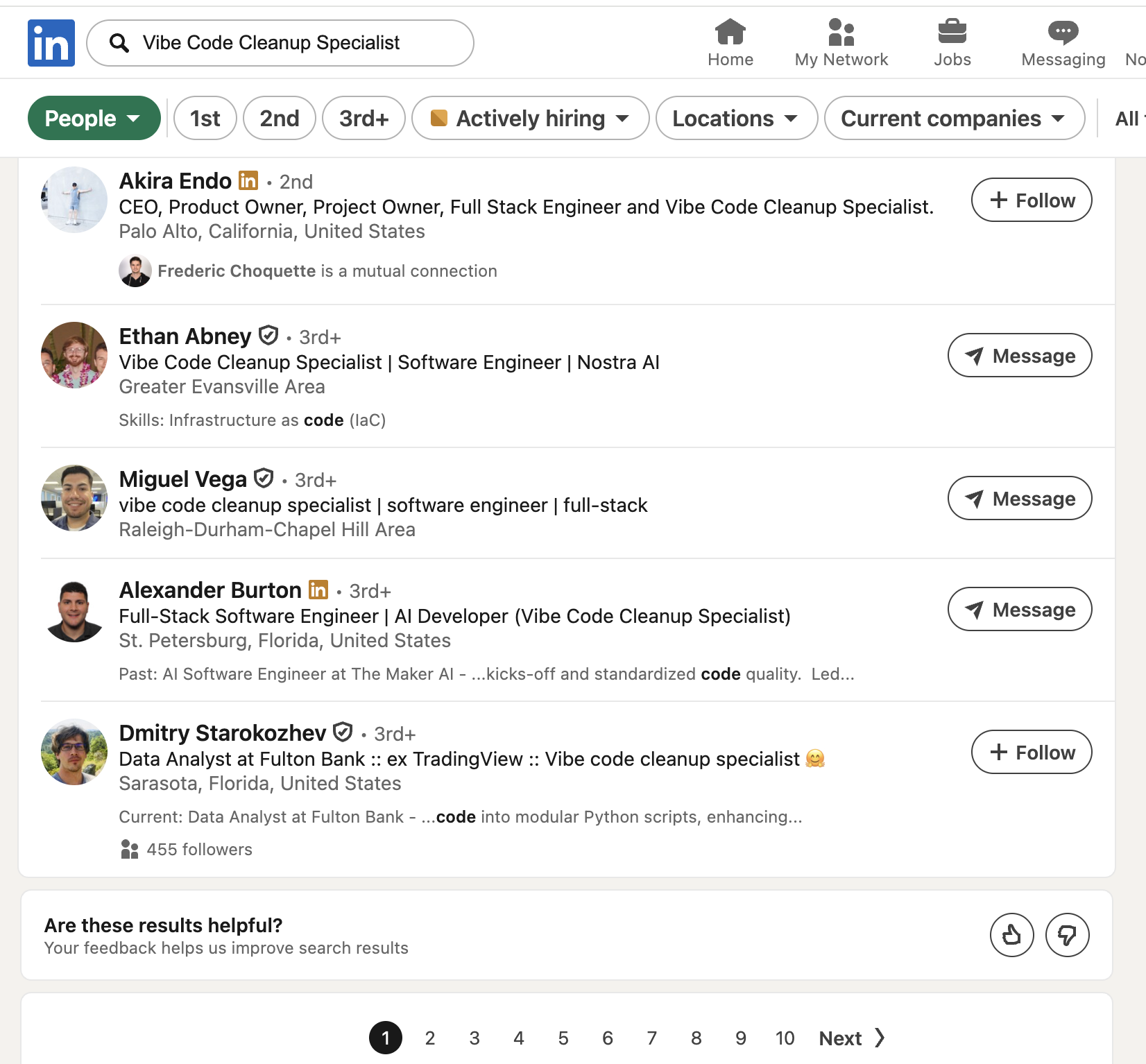
Don’t be the reason your boss has bring in a Vibe Code Cleanup Specialist.
Going forward I will use terms like “build with AI”, “agentic coding,” “ai-assisted coding”, “AI builder”, “full-stack product builder”, and “AI engineer” to describe what we are striving to do and become. To do these terms justice we will follow a rigorous development process guiding AI to write code that will stand up to scrutiny in a world class engineering organization.