
STRAT 325 - Intro to Management Consulting
Syllabus
| Term | Winter 2026 |
| Instructor | Scott Murff |
| TAs/Coaches | Carson Fellows, Tatum Frazier, Ambrose Aggabao, EJ Smith, Grant Hill, Avery Pate, Grace Dyer, David Fillmore |
| Class Time | Tuesday/Thursday 12:30 – 1:45 PM |
| Location | W240 |
| Office Hours | By Appointment |
| LMS | Canvas |
Course Overview
Welcome to Intro to Management Consulting (STRAT 325). This course teaches you how top-tier consulting firms expect their people to work, organized around the Consultant diamond.
The Consultant Diamond
The course is organized around four things the people you work with can see and rate: Judgment, Ownership, Communication, and Collaboration. Together they form the Consultant diamond. Teammates, clients, and TAs rate each axis 1 to 5 against written behavioral anchors.
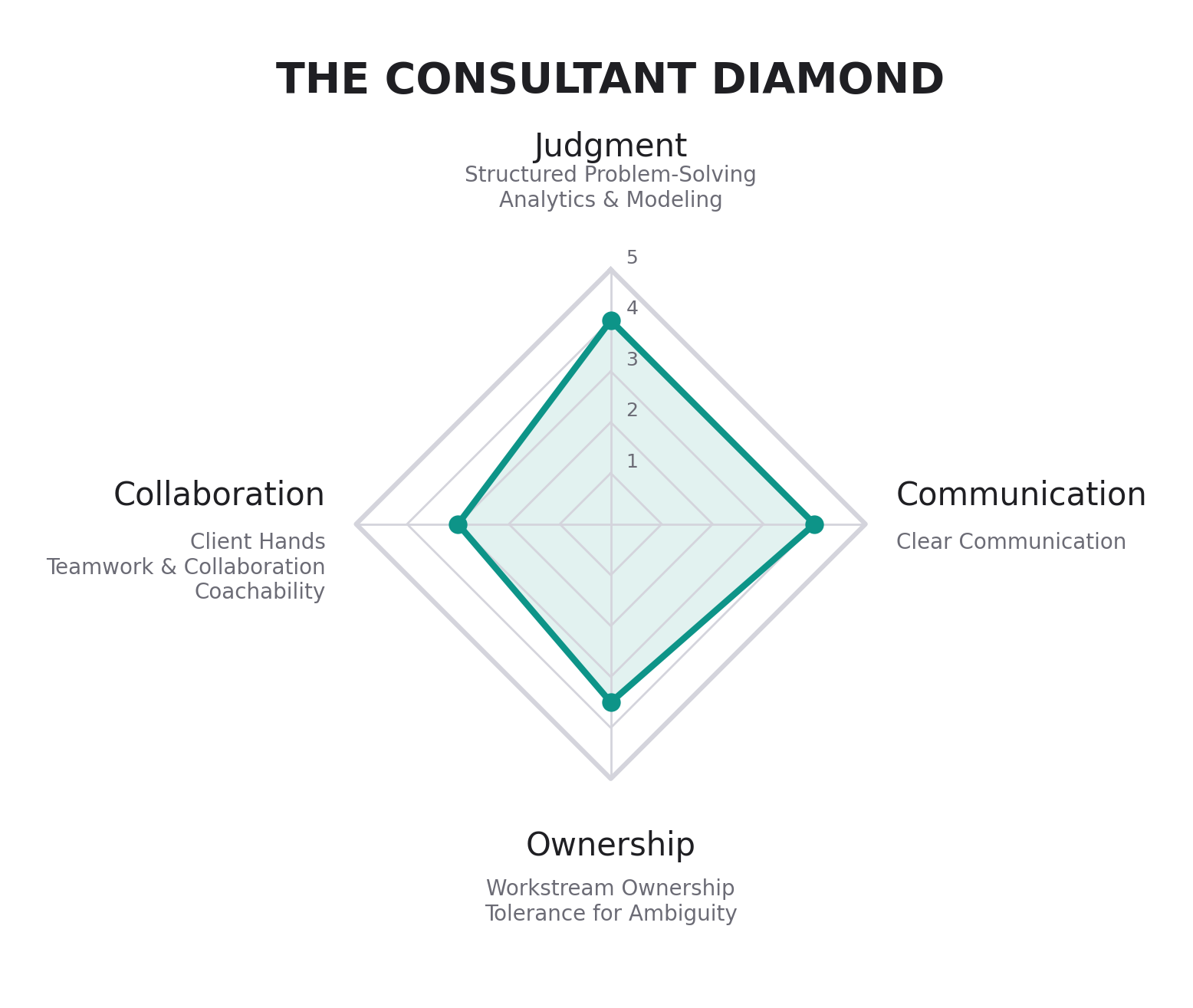
Under each axis sit the toolkit skills you will build, eight in all. Each has its own section in the chapters.
| Axis | Skill | What It Means |
|---|---|---|
| Judgment | Structured Problem-Solving | Decompose ambiguous problems using MECE logic and hypothesis-driven thinking |
| Analytics & Modeling | Build models in Excel, Python, or other quantitative tools; test hypotheses against data; estimate with confidence | |
| Ownership | Workstream Ownership | Act with high agency; own work end-to-end; anticipate needs and drive outcomes without waiting to be told |
| Tolerance for Ambiguity | Navigate uncertainty; make progress without complete information | |
| Communication | Clear Communication | Synthesize findings into an answer; apply the Pyramid Principle; write action-titled slides; deliver crisp verbal updates |
| Collaboration | Client Hands | Interact professionally with senior stakeholders; build trust through credibility |
| Teamwork & Collaboration | Collaborate across team structures; give and receive feedback effectively | |
| Coachability | Incorporate feedback rapidly; demonstrate growth through iteration |
You’ll apply the diamond to two course goals:
| Goal | Focus | Outcome |
|---|---|---|
| Land an Offer | Networking, resume, case interviews, behavioral stories | Secure or make progress towards a consulting internship |
| Do Client Work | Company analysis, competitive benchmarking, strategic proposals | Deliver real consulting work |
These goals reinforce each other. The same diamond that helps you structure a case interview helps you deliver impactful client work. The same approach that builds your networking skills builds trust with stakeholders.
AI at the Core
AI is not a separate topic. It’s how you’ll apply every skill in this course. From the start of the course, you’ll learn to use AI tools (Claude Code, VS Code/Cursor/Antigravity) to accelerate your research, analysis, and communication. Every project expects AI-assisted work.
Learning Outcomes
| # | Learning Outcome | BYU Aims Supported |
|---|---|---|
| 1 | Define and solve client problems using MECE logic, issue trees, and hypothesis-driven analysis | Intellectually Enlarging |
| 2 | Use AI-assisted tools (e.g., Claude Code, Gemini) to gather outside-in insights, build models, and test hypotheses with transparency and integrity | Lifelong Learning and Service; Character Building |
| 3 | Communicate clear, executive-level recommendations using the Pyramid Principle and visual slide design | Intellectually Enlarging; Character Building |
| 4 | Demonstrate Christlike professionalism through humility, judgment, and trustworthiness in team and client interactions | Spiritually Strengthening; Character Building |
| 5 | Prepare for consulting interviews and internships by articulating a clear value proposition through resumes, networking, and behavioral interviews | Lifelong Learning and Service; Spiritually Strengthening |
Client Work Projects
Projects are progressive — each builds on the last. You choose a public company and develop increasingly sophisticated deliverables:
| Project | Scope | Team | Deliverable |
|---|---|---|---|
| P1: Intelligence Brief | Outside-in analysis surfacing a key tension | Individual | 4-6 slides |
| P2: Point of View | Take a position on what the company should do | Individual | 5-8 slides |
| Capstone: Conversation Deck | Polished deck + real outreach to the company | Individual | 6-10 slides + outreach |
All projects expect AI-assisted research and analysis. See Assessments for full descriptions, rubrics, and requirements.
Grading
Grades are based on four categories: Reading Quizzes, Resume & Networking, Practice Interviews, and Client Work (P1, P2, Capstone). See Canvas for the authoritative grade breakdown and due dates.
Grading Scale
| Letter | Range | GPA |
|---|---|---|
| A | 93–100% | 4.0 |
| A- | 90–92% | 3.7 |
| B+ | 87–89% | 3.4 |
| B | 83–86% | 3.0 |
| B- | 80–82% | 2.7 |
| C+ | 77–79% | 2.4 |
| C | 73–76% | 2.0 |
| C- | 70–72% | 1.7 |
| D+ | 67–69% | 1.4 |
| D | 63–66% | 1.0 |
| D- | 60–62% | 0.7 |
| E | Below 60% | 0.0 |
Late Work Policy
Late work accepted up to 9 days late with a 10% penalty per day:
| Days Late | Penalty |
|---|---|
| 1-3 | -10% to -30% |
| 4-6 | -40% to -60% |
| 7-9 | -70% to -90% |
| 10+ | No credit |
Interview Prep Components
Practice Interviews
Practice interviews combine behavioral and case components, mirroring the actual MBB interview format. Complete 10 practice interviews as the interviewee throughout the semester:
| Source | Sessions | Notes |
|---|---|---|
| Pod peers | 7 | Practice with pod members |
| TA | 3 | TA coaching sessions |
| Total | 10 |
You’ll also serve as interviewer for 7 peer interviews. Each session includes behavioral questions (~15-20 min) followed by a case (~25-30 min), with feedback afterward. See Practice Interviews for the full format, scoring rubrics, and feedback framework.
Behavioral Stories
Build a bank of 3-5 polished stories using the STAR framework for common behavioral questions. You’ll practice delivering these stories live during your practice interviews.
Networking Tracker
Maintain a tracking spreadsheet documenting outreach, smoothie chats, and relationship building. Your TA will review progress during TA Mentoring Sessions.
TA Pod Structure
You’ll be assigned to a pod of 6 students with a dedicated TA who mentors you all semester. Your pod serves as:
- Support system: People rooting for your success
- Practice interview partners: 5 peers to practice with
- Peer feedback: Resume reviews, story refinement, honest input
| TA Touchpoint | Timing |
|---|---|
| Goals Chat | Early semester |
| TA Session 1 | Baseline assessment |
| TA Session 2 | Progress check |
| TA Session 3 | Final evaluation |
Your TA is your primary resource for feedback, coaching, and support. The same TA conducts all 3 mentoring sessions so they can track your growth over the semester.
Instructor Bio
Scott Murff is an Associate Teaching Professor of Strategy at the BYU Marriott School of Business, where he also serves as program director and teaches courses on management consulting, product management, and artificial intelligence. He brings over 15 years of experience at the intersection of business and technology, having worked as a consultant, product manager, and data scientist.
Prior to joining BYU, Scott spent nearly seven years at McKinsey & Company in roles ranging from analytics specialist consultant to principal product manager, where he led product development and performance management initiatives for Fortune 500 clients.
Scott holds a Master’s degree in Management Science & Engineering from Stanford University and a B.A. in Economics from BYU.
Required Materials
- LMS: Canvas (used for turning in assignments, viewing grades, and the weekly schedule. See this course website for readings, assessment descriptions, and career reference material)
- Laptop: Mac or Windows with ability to run VS Code or Cursor
- AI Access: Paid or free versions of one or more of Claude Code, Gemini, Codex, Github Copilot CLI, Cursor, Antigravity
Recommended readings will be provided through the course website.
Classroom Culture
Laptop Policy
Laptops may be used for note-taking and class-related purposes. Avoid activities that would distract nearby students.
Cold Calling
I teach in a conversational style that includes cold calling. If you’d rather I not cold call on you, please let me know on the first day of class.
Office Hours and Help
- Start with AI tools and the course website
- Use email teams to ask classmates
- Attend TA or Professor office hours
- Contact your TA via email
- Contact Professor Murff via email
University Policies
Mission and Aims
The mission of Brigham Young University, founded, supported, and guided by The Church of Jesus Christ of Latter-day Saints, is to assist individuals in their quest for perfection and eternal life.
BYU seeks to develop students of faith, intellect, and character who have the skills and the desire to continue learning and to serve others throughout their lives.
A BYU education should be (1) spiritually strengthening, (2) intellectually enlarging, and (3) character building, leading to (4) lifelong learning and service.
Marriott School Values
Building on the foundational Mission and Aims, the Marriott School of Business aspires to transform the world through Christlike leadership, guided by:
- Faith in Christ – Deep and abiding faith gives us capacity to envision a better future
- Integrity in Action – Acting with integrity builds trust and strengthens character
- Respect for All – Recognizing the inherent worth and divine potential of each person
- Excellence – Pursuing excellence in learning, teaching, and leadership