
What This Looks Like at Full Scale
Everything in the workshop so far has been one builder directing a few agents. This closing segment shows the same pattern run by an engineering organization all day. In September 2026, Gergely Orosz published an account of what OpenAI internally calls its agentic software factory.
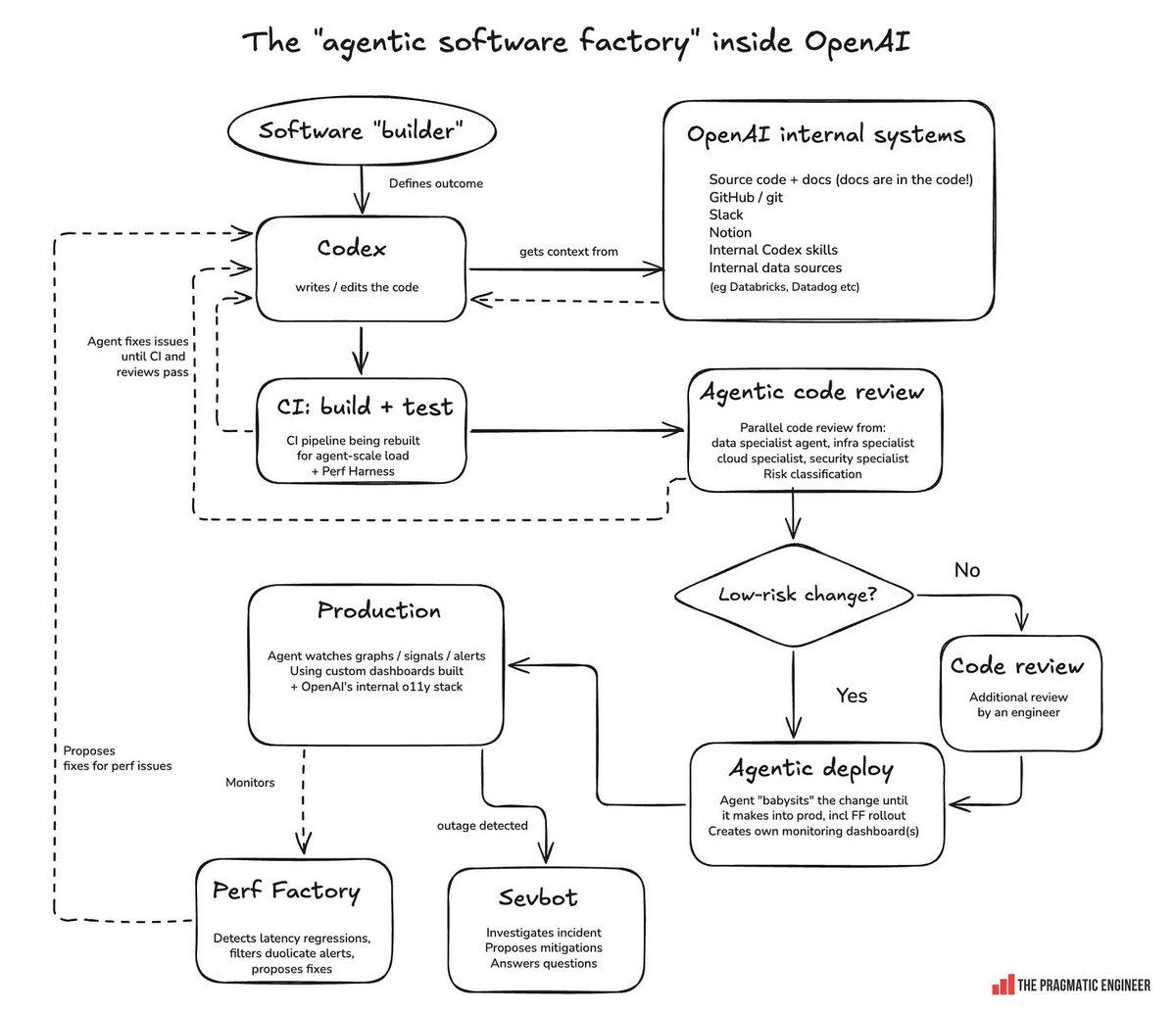
Trace the diagram. A human, labeled the software builder, defines the outcome. Everything downstream is an agent. Codex writes the code, pulling context from where it lives: the repo, GitHub, Slack, Notion, internal data sources. CI (continuous integration, a system that builds and tests every change automatically) runs, and when it fails the agent fixes its own work and tries again instead of handing a failed build back to a person. Specialist agents review in parallel, one for data, one for infrastructure, one for security, and classify how risky the change is. Only risky changes go to a human engineer. Low-risk changes go straight to an agent that deploys them, monitors the rollout, and builds its own monitoring dashboard. Two more agents watch production: Perf Factory catches latency regressions (changes that make the product slower to respond) and proposes fixes, and Sevbot investigates incidents and proposes mitigations. Both send their fixes back to Codex.
Figures from the same piece: use of Codex in non-engineering departments at OpenAI went from roughly zero to about 90 percent between February and May 2026, nearly everyone at the company uses it weekly, and pull request volume across the company rose roughly tenfold in six months.
Three things worth a PM’s attention
The human’s job is the outcome. There is one oval at the top, and it is a definition of done. That is the job you practiced in the Lab when you wrote acceptance criteria with /spec before letting the agent build. The scarce skill in this picture is judgment about what should be built and what “good” means.
Verification is the bottleneck. Most of the diagram is CI, review, risk classification, deploy monitoring, and incident response. When writing code gets cheap, everything that checks the code becomes the constraint.
| Term | What it means |
|---|---|
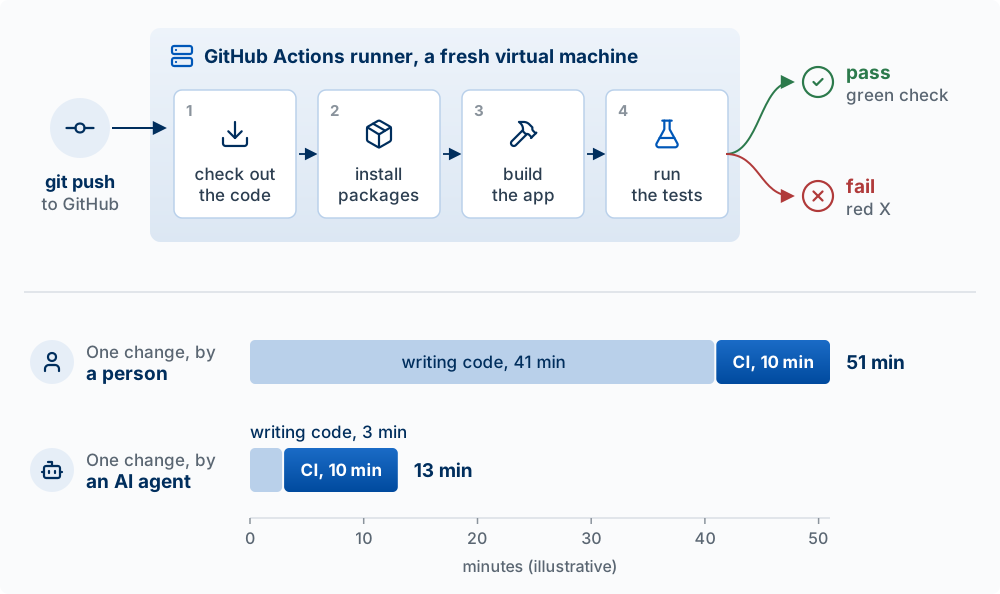
| GitHub Actions | GitHub’s CI service. A file in .github/workflows/ lists the steps and when to run them, such as on every push |
| Runner | The machine that runs the steps. GitHub starts a fresh virtual machine for each run and deletes it afterward, so nothing left on your laptop can make the app pass by accident |
| Build | Turning source code into the files that run. It fails on errors such as a missing file or a type error |
| Tests | Programs written ahead of time that run parts of the app and check the results. They catch only what someone wrote a test for |
Risk classification decides where the human goes. The diamond in the middle is the design decision that makes the system work. Not every change needs a person, and sending every change to one moves the bottleneck to that person. Deciding which changes deserve your attention is the blast-radius judgment: how far does it reach, and can it be undone?
You are running a small version of this factory
Each part of the factory has a counterpart in the Agent Team Kit. Placing each on the three layers shows how much it can guarantee.
| Factory | Agent Team Kit | Where it sits |
|---|---|---|
| Software builder defines the outcome | You, writing a spec with acceptance criteria and approving it before any code exists (/spec) |
A person |
| Context layer: what Codex pulls from the repo, Slack, and Notion | CLAUDE.md and team memory for rules and lessons; MCP servers for the tools your context lives in |
Read by the model; adds tools |
| Reusable agent procedures | Skills: /spec, /build-spec, /stage, /promote, /push |
Read by the model |
| CI gates | The bash-guard and file-size hooks and your permission rules, which hold whatever the model decides. The pre-commit and pre-push git hooks run the checks again before work leaves your laptop. CI on every push is the part you write yourself |
Applied by the harness; git hooks outside the layers |
| Agentic review | The definition-of-done section in CLAUDE.md, /build-spec’s check sheet, /regression-check, and the agents that test your app |
Read by the model |
| Risk classification | The release decision in the spec: /push straight to production, or /stage then /promote (decide the release at spec time) |
A person |
| Perf Factory and Sevbot watching production | The closest counterpart is the bug feedback loop: in-app reports and tester findings land in one inbox and hand off to /fix-bug |
A build spec in your app, plus a skill |
Two differences matter more than scale. In the factory, an agent classifies risk and routes the change; in the kit, you make that call when you write the spec. And the factory’s review agents are a required gate, while most of the kit’s review is read by the model, so it holds only as well as the model follows it. The kit’s hooks and git hooks are the parts that hold every time.
After the workshop
- Install the kit in one real project, following the Lab steps on a clean tree. The Kit Reference lists every piece.
- Add one deny rule and one ask rule for the actions that leave your laptop, and run the push drill from Advice Versus Enforcement to see them hold.
- Write your next feature as a spec with
/spec, and build it with/build-spec. - Read further. The kit repo has the design notes behind every hook and skill, and Scott’s Product Management book covers the full builder workflow, including Directing the Agent.