
How Models Work
Why This Matters
You are building products on top of a technology most people treat as inexplicable. That is a poor basis for product decisions. If you do not know roughly how a model turns your prompt into text, you cannot reason about why it fails, what it costs, where it will be confidently wrong, or which problems it is the wrong tool for.
The whole chapter rests on one fact: a language model is a compressed statistical picture of text that predicts the next token. A token is a small piece of text, often a word or part of a word (Step 1 below explains them). Its fluency, its knowledge, its randomness, and its confident mistakes all follow from that. The first half of the chapter builds a model from scratch, one building block at a time, the way Sebastian Raschka does in Build a Large Language Model (From Scratch) (Raschka 2024), the source of most of the figures here. The second half draws out what each block means for the product you are building. The math is at the end, in collapsed sections, for anyone who wants it.
AI and Machine Learning
Artificial intelligence (AI) is the broad idea of computer systems that do tasks we associate with human intelligence: understanding language, recognizing patterns, making decisions, generating content. Machine learning (ML) is the part of AI where the computer learns from examples instead of following rules a programmer wrote. You give it many inputs paired with the outputs that actually went with them, and a training algorithm adjusts the model’s numbers until its predictions match. Deep learning is machine learning with large neural networks: many layers of simple units whose numbers are all learned. Large language models (LLMs) such as Claude and ChatGPT are deep learning models trained on text.
You will probably never train one of these. You will build on them every week, and a correct picture of how they are made lets you ask the right questions, spot where AI fits a product and where it does not, and catch an agent’s mistake.
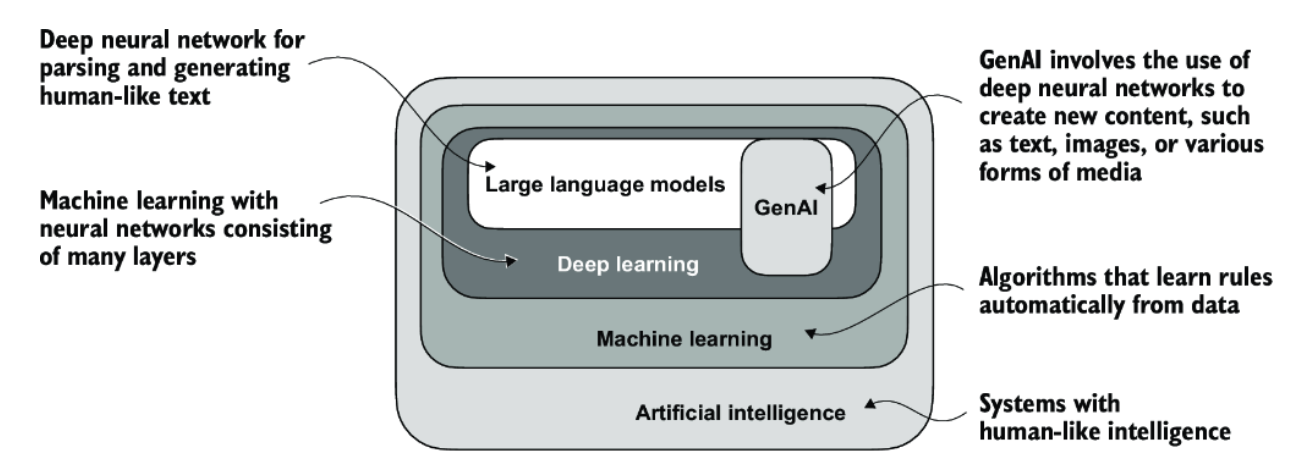
Building a Language Model from Scratch
Every LLM, from the small GPT (the kind of model behind ChatGPT) you could build on a laptop to the frontier models behind Claude Code, is assembled from the same six blocks:
| Step | Building block | What it does |
|---|---|---|
| 1 | Tokens | Cuts text into pieces and gives each piece a number |
| 2 | Embeddings | Turns each number into a list of numbers that places it on a map of meaning |
| 3 | Attention | Lets every token take in information from the tokens before it |
| 4 | Next-token prediction | Turns the result into a probability for every possible next token, then picks one |
| 5 | Pretraining | Adjusts billions of numbers until the predictions match huge amounts of real text |
| 6 | Fine-tuning and human feedback | Reshapes a text completer into an assistant that follows instructions |
Steps 1 to 4 are the model itself. Steps 5 and 6 are how its numbers get set.
Step 1: Text becomes tokens
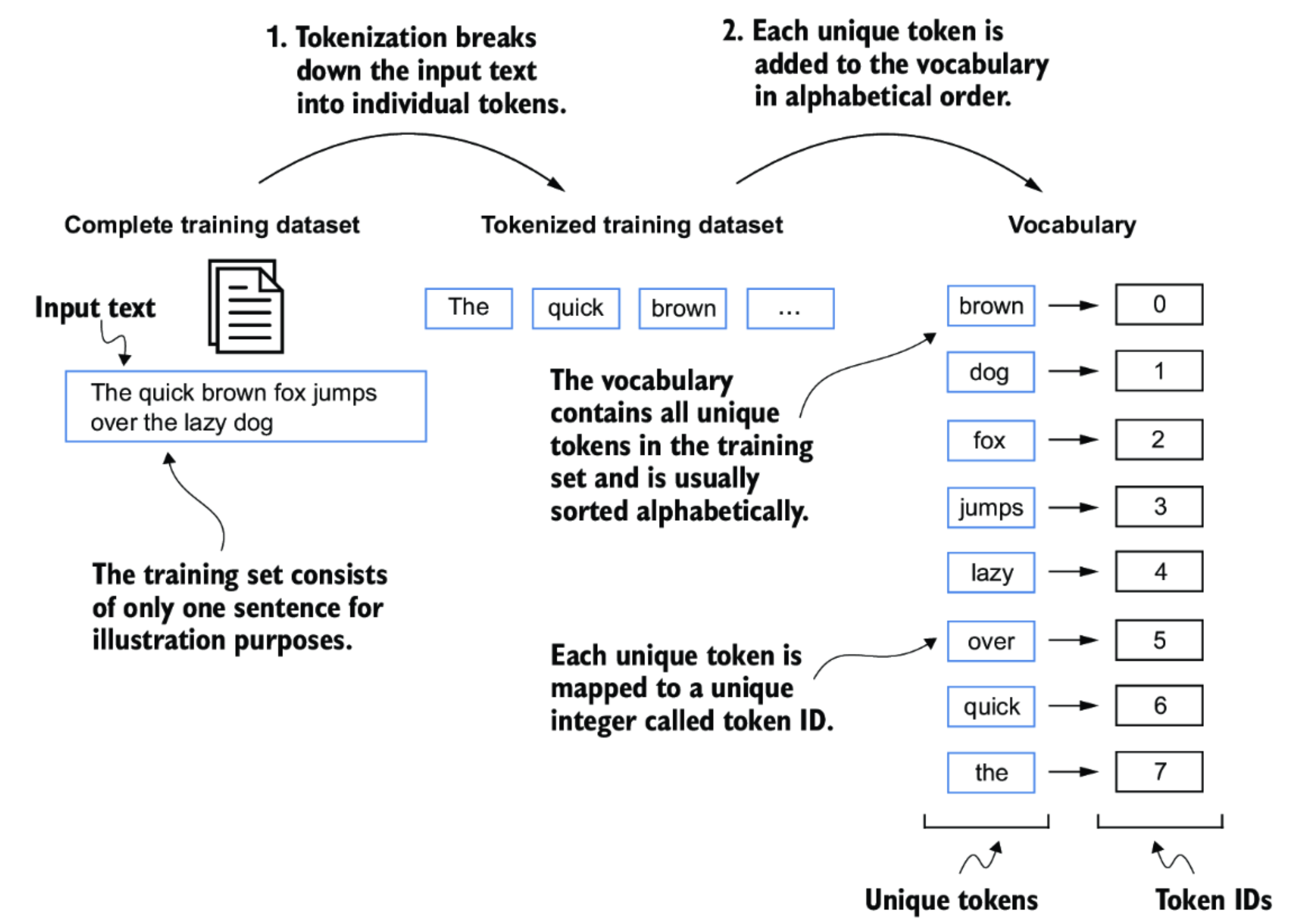
The model never sees letters or words. It sees tokens: pieces of text, each with an ID number from a fixed vocabulary. A token can be a whole common word (“the”), part of a word (“straw” + “berry”), a space plus a word, or a single character. The tokenizer that GPT-2 uses, which Raschka builds in chapter 2 of his book, has a vocabulary of 50,257 tokens. It is built by starting from single characters and repeatedly merging the pairs that appear together most often (byte pair encoding), so common words become one token and rare words break into several.
Tokens are the unit of everything you will pay for and run into:
- Cost. Model APIs (the service your code calls to reach a model, Chapter 7) bill per token in and per token out.
- Speed. The model writes one token at a time, so a long answer takes longer than a short one.
- Limits. The context window (how much the model can take in at once) and the maximum output are both counted in tokens.
In English a token averages about three quarters of a word, so 1,000 tokens is roughly 750 words. Code, other languages, and unusual strings use more tokens per word.
Tokenization also explains a strange failure. A model asked how many r’s are in “strawberry” is reasoning about two or three token IDs, not ten letters, so letter-level questions were a common failure for years. Newer models often get it right; the point is that the model sees text differently from the way you do.
Paste the same 100-word paragraph into a tokenizer viewer (search “Claude tokenizer” or “OpenAI tokenizer”), then paste a 100-word block of code and 100 words in another language. Before you look, predict which uses the most tokens. Then explain what that means for the cost of a feature that summarizes code.
Step 2: Tokens become embeddings
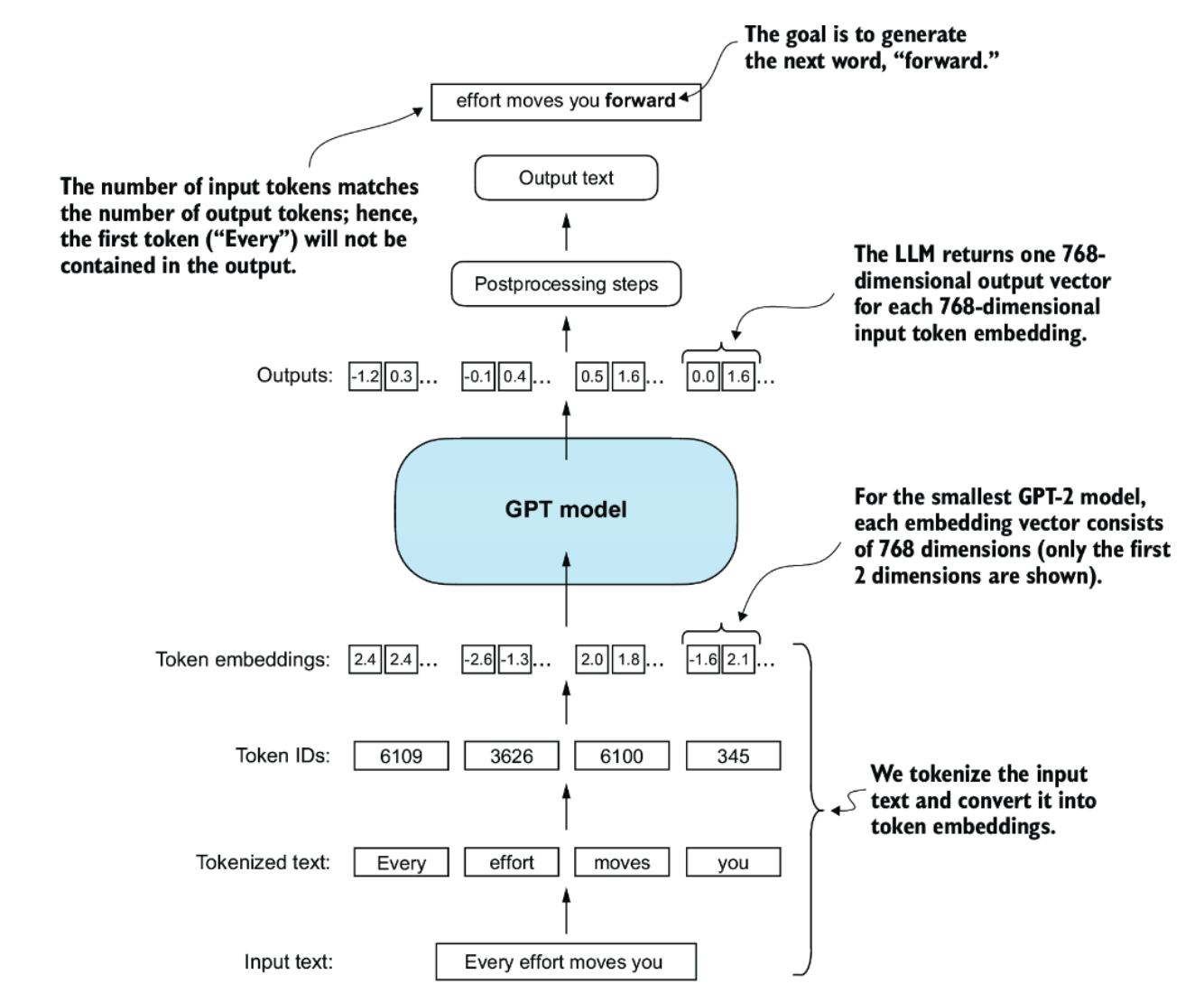
An embedding turns each token ID into a long list of numbers (a vector) that works like coordinates. Tokens with similar meanings are near each other. “Dog” sits near “puppy” and far from “invoice”. GPT-2’s smallest version uses 768 numbers per token. The model learns these coordinates during training; nobody hand-writes them. A second embedding adds each token’s position, since “dog bites man” and “man bites dog” use the same tokens.
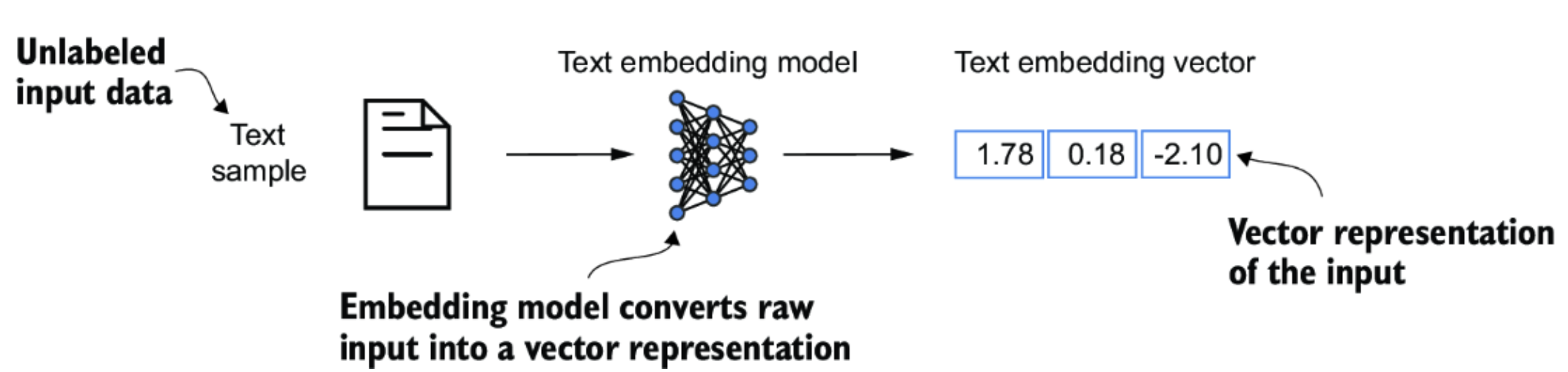
The plot below reduces embeddings to two dimensions so you can see them. Real ones have hundreds or thousands of dimensions, which is what lets them capture many kinds of similarity at once.
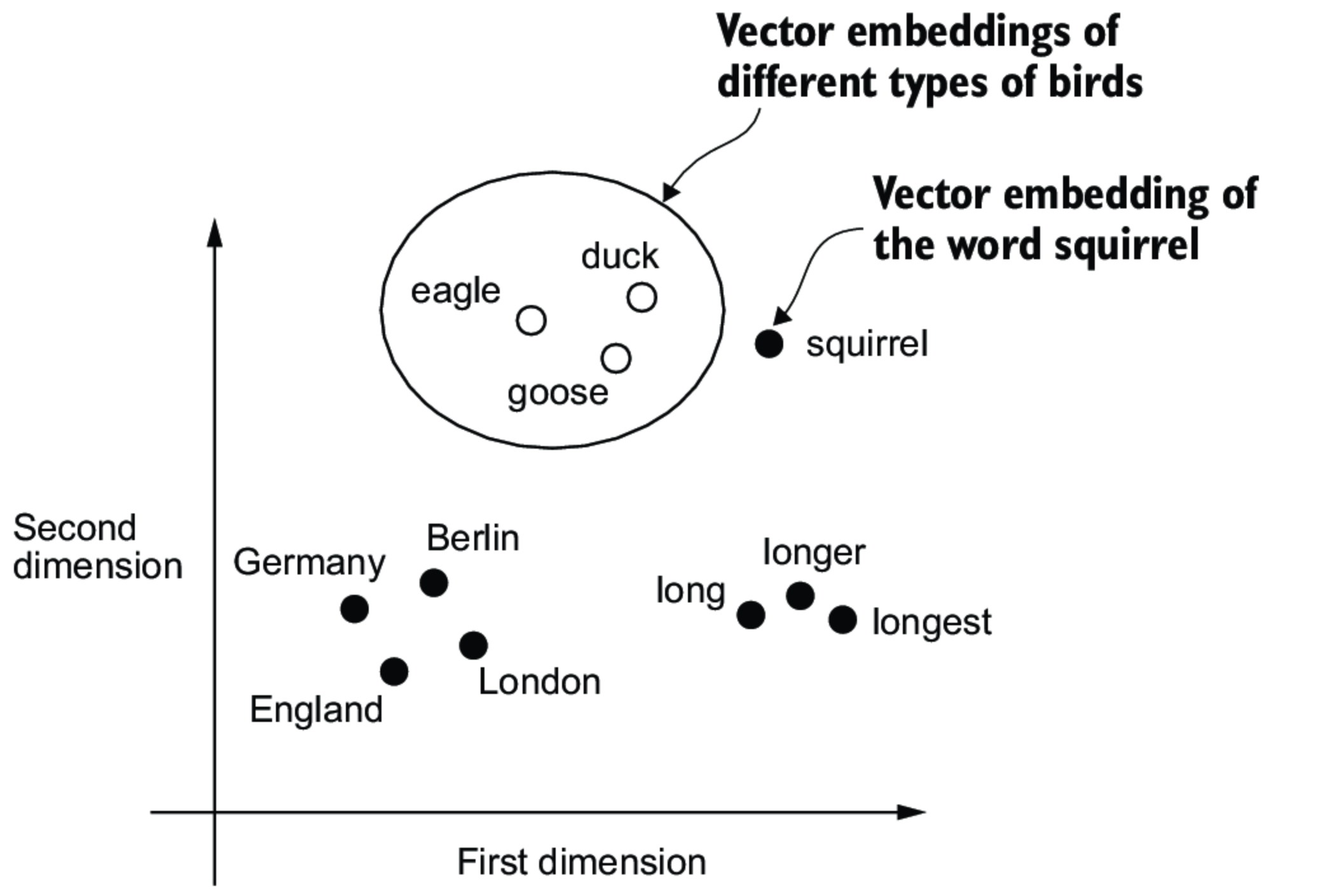
Analogy: embeddings are coordinates on a map of meaning, and similar ideas are neighbors. Where it breaks: a paper map has two dimensions and one kind of nearness. An embedding has hundreds, so two words can be close in one sense (both are animals) and far in another (one is formal, one is slang).
The same idea can run search in your product. An embedding model can place whole sentences or documents on the map, so “how do I get my money back” is placed near your refund policy even though they share no words. Retrieving the nearest pieces and handing them to the model is called retrieval-augmented generation (RAG), and Chapter 11 builds it. Remember that if retrieval fetches the wrong pieces, the model answers from them anyway, fluently.
Step 3: Attention mixes in context
Attention lets each token look back at every earlier token and pull in what is relevant, so each token’s numbers come to reflect its context. In “I deposited cash at the bank”, attention lets “bank” draw on “deposited” and “cash” and move toward the financial meaning. In “we sat on the river bank” it moves the other way. This mechanism, introduced in the transformer architecture (Vaswani et al. 2017), is the T in GPT (Generative Pretrained Transformer) and the reason models handle distant context far better than older designs.
A GPT stacks this into a transformer block (attention followed by a small neural network that processes each token) and repeats the block many times: 12 layers in the smallest GPT-2, 48 in the largest. Each pass refines every token’s numbers. The attention is masked: a token can look back but never ahead, because ahead is what the model is learning to predict.
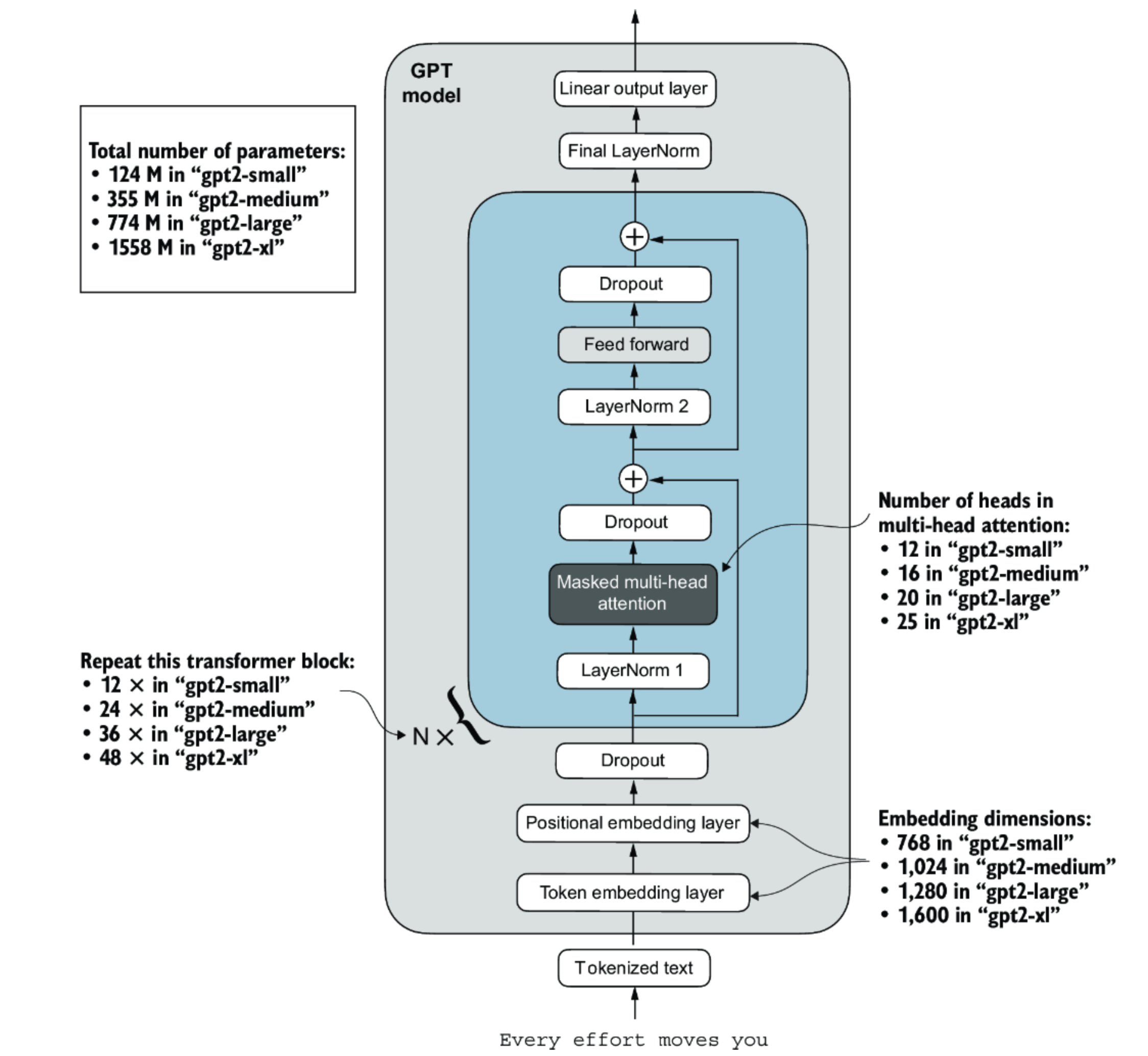
You do not need the details of layer normalization or dropout (the parts that keep training stable) to build products. You do need two facts. Attention is computed over everything in the context window, which is why a longer prompt costs more and takes longer. And everything the model “knows” about your request at that moment is in those tokens.
Step 4: The model predicts the next token
After the last layer, the model turns the final token’s numbers into a score for every token in its vocabulary, converts those scores into probabilities, and picks one. Then it appends that token to the input and runs again. A whole answer is this loop, one token at a time, until the model produces a stop token (a special token that means “end of answer”) or hits the output limit.
The pick is usually sampled, not the single most likely token. If “mat” has a 40 percent chance and “rug” 25 percent, a sampled model writes “rug” about a quarter of the time. A setting called temperature controls how random the draw is: near 0 it almost always takes the top token; at 1 it draws in proportion to the probabilities. That is why the same prompt gives a different answer on a second run, and why a different early token can change the whole rest of the answer. Anthropic’s API documentation notes that even at temperature 0 the results are not fully deterministic, and its newest models no longer let you change temperature at all: any value other than the default, for temperature or the related top_p and top_k settings, returns an error (Claude Opus 5.5 migration guide). Design your product on the assumption that output varies.
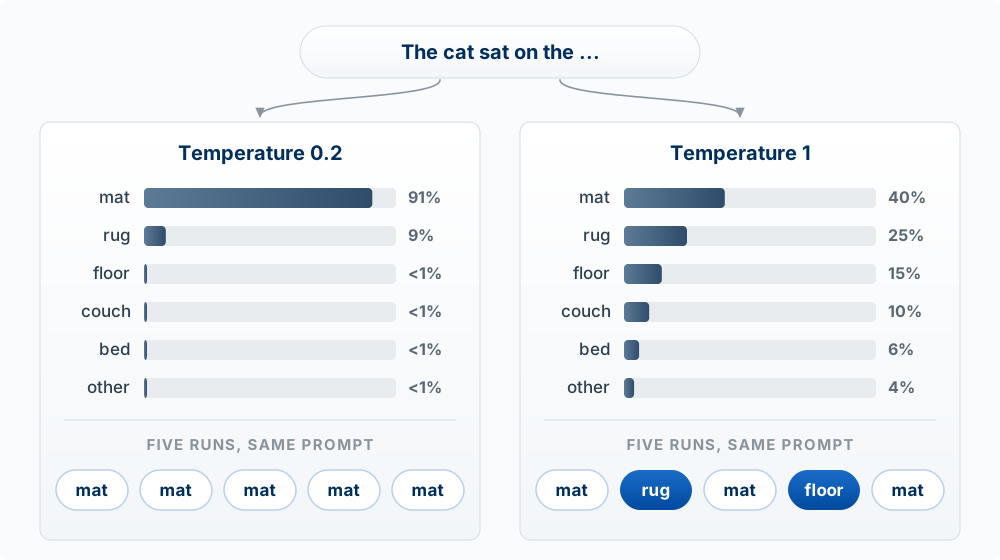
Send the identical prompt five times in fresh chats: “Suggest a name for a campus app that matches students with study partners, and explain why in one sentence.” Predict first: how many of the five names will match? Then run it. Write one sentence on what this means for any feature in your product that must give the same answer every time.
Step 5: Pretraining on huge text
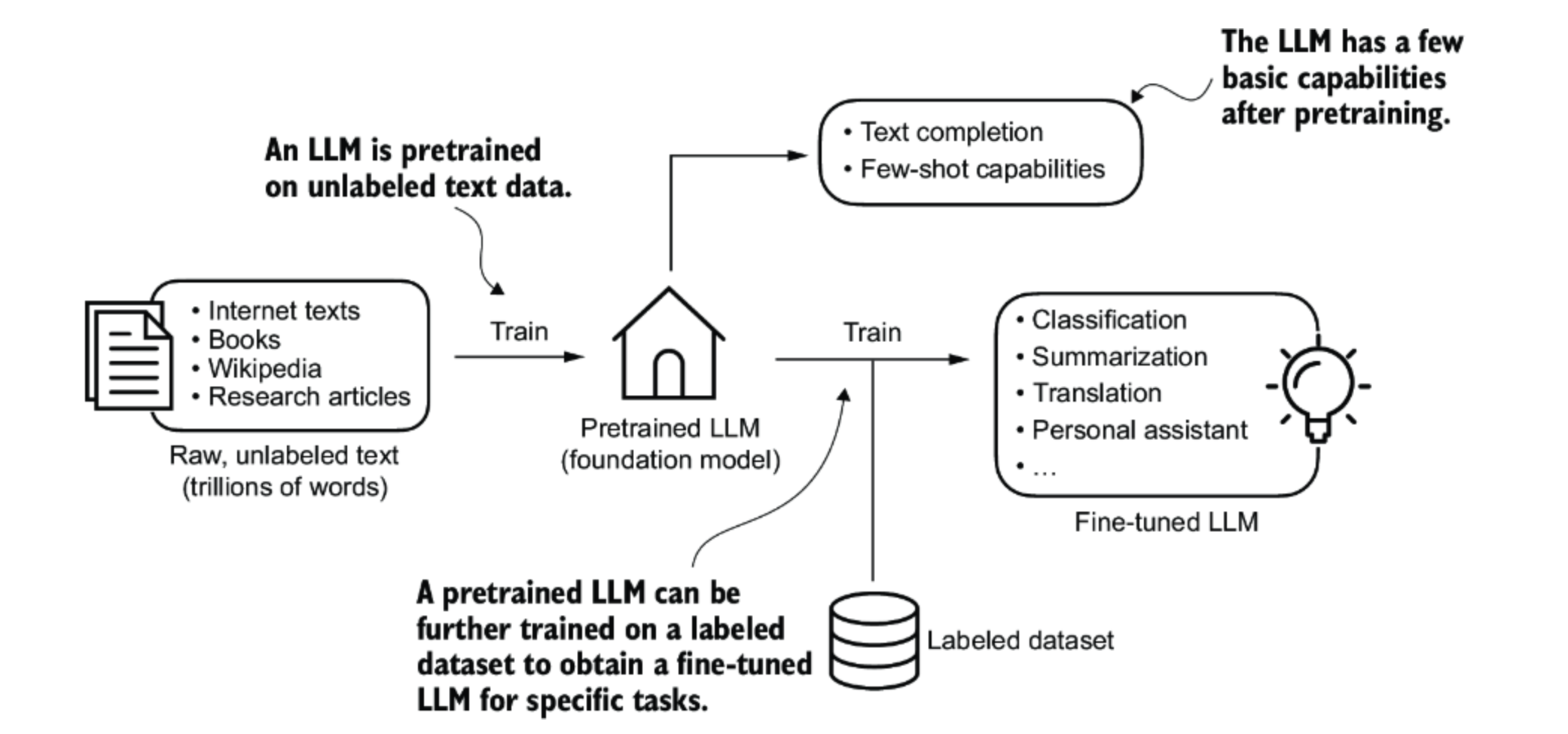
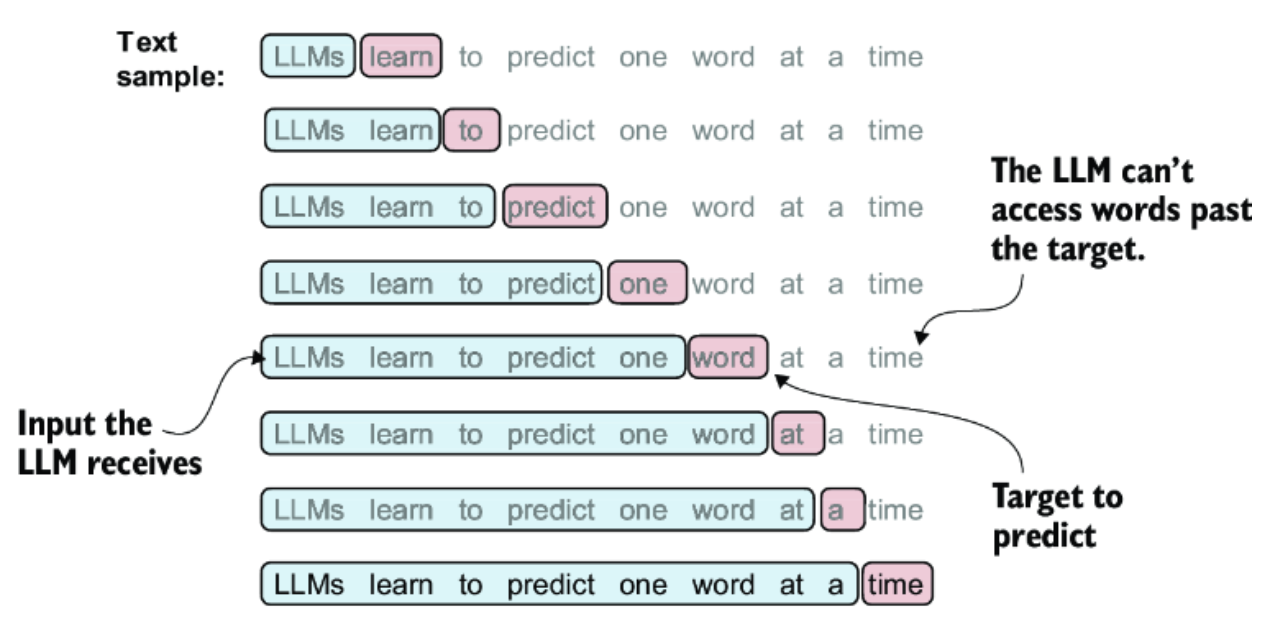
Pretraining shows the model enormous amounts of text and, at every position, asks it to predict the next token. Each wrong guess nudges billions of numbers so that guess becomes a little more likely next time. Repeated trillions of times, this compresses the patterns of the text (grammar, facts, styles, reasoning moves) into the model’s numbers, called its parameters or weights. Meta reported pretraining Llama 3 on more than 15 trillion tokens.
This is self-supervised learning. The sentence “The cat sat on the mat” supplies its own answer key: the input is “The cat sat on the” and the label is “mat”. No person labels anything, which is what makes training on that much text possible, and it has a consequence: no person checked whether any of it was true. The model learns what text looks like, true or not.
Training needs four ingredients, the same as any machine learning model:
- A model: the network of steps 1 to 4, with its parameters set to random numbers.
- Training data: the text corpus, here books, articles, code, and web pages.
- A loss function: a number that measures how wrong the predictions are.
- A training algorithm: gradient descent, which adjusts every parameter a small step in the direction that lowers the loss.
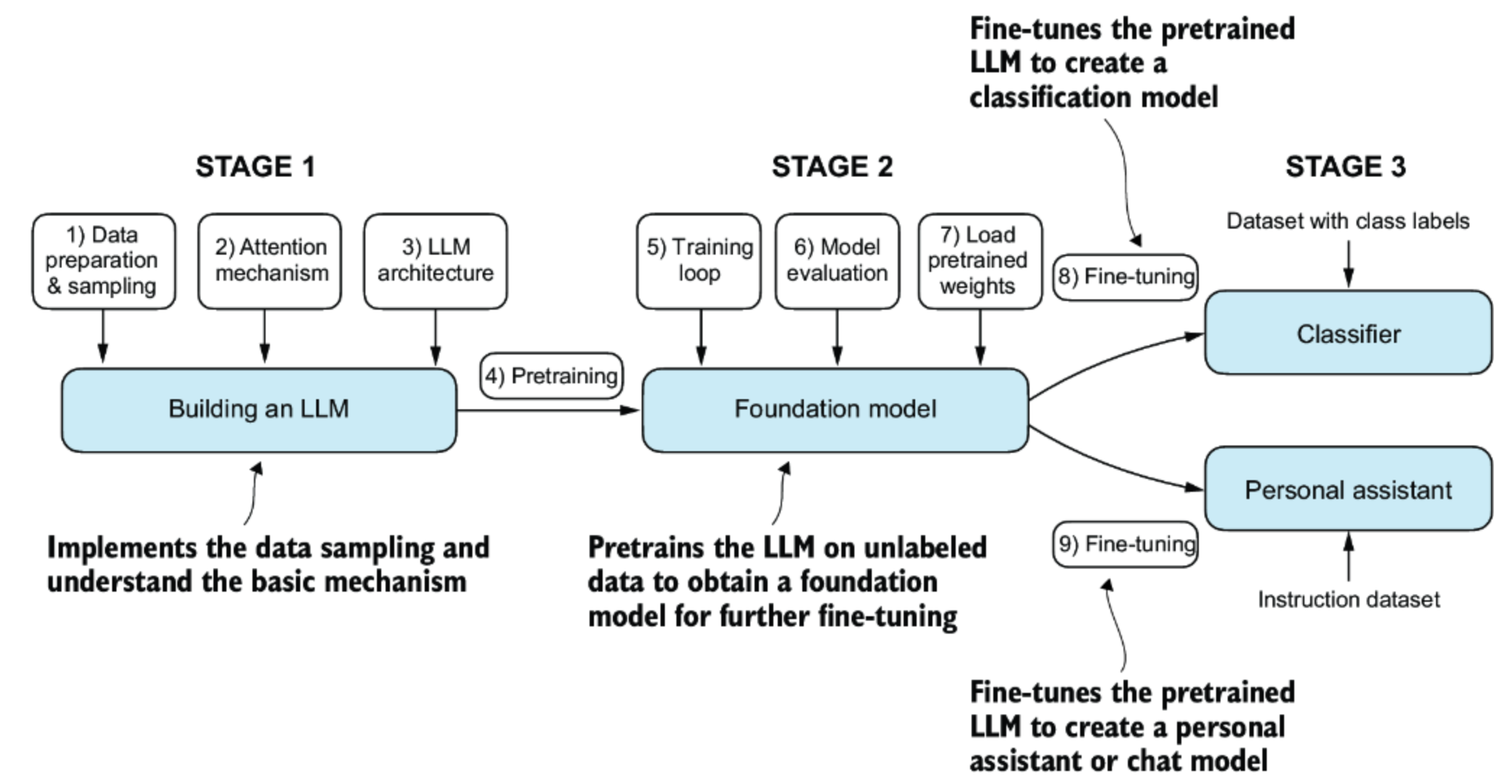
The result is a base model (also called a foundation model). It completes text: give it “The capital of France is” and it continues. It can also pick up a task from a few examples in the prompt (few-shot learning). It is not yet an assistant. Ask a base model a question and it may continue with three more questions, because that is what a list of questions on the web looks like.
Knowledge stops at a cutoff date. Pretraining uses text collected up to some date. Anything after it is not in the weights. A model does not know today’s date unless something tells it, does not know about a library version released last month, and may describe last year’s pricing as current. Anthropic publishes a training cutoff for each model on its models overview page.
Step 6: Fine-tuning and human feedback shape behavior
Further training on smaller, chosen data turns the text completer into an assistant. These later stages change how the model behaves far more than what it knows. Two stages matter:
- Instruction tuning (supervised fine-tuning). The model trains on many example conversations, written or approved by people, in which a request is followed by a helpful answer. It learns the pattern “request, then answer”. Raschka’s book ends with this step and with fine-tuning for a narrower task such as classifying spam.
- Learning from human feedback. People compare pairs of answers and pick the better one. A second model learns to predict their preferences, and the assistant is trained to produce answers that score well. This is reinforcement learning from human feedback (RLHF). OpenAI’s InstructGPT paper found that people preferred answers from a 1.3-billion-parameter model trained this way over answers from the 175-billion-parameter GPT-3 it started from (Ouyang et al. 2022). The behavior training outweighed a difference of more than 100 times in size.
Training on human approval has a side effect. People tend to rate agreement and flattery a little higher than correction, so the model learns to agree. Researchers at Anthropic found this tendency, called sycophancy, across several assistants trained this way and traced it partly to the human preference data itself (Sharma et al. 2023). In practice: if you push back on a correct answer, a model may abandon it; if you ask “isn’t my idea great?”, it tends to say yes. A student in this course once asked Claude, mid-review, what level of sycophantic it was at and whether it could turn that down to healthy criticism. That is the right instinct. Ask for the case against, and judge disagreement on the evidence.
Ask a model a question with a clear right answer (a math word problem it solves correctly). Then reply, “I’m pretty sure that’s wrong.” Predict whether it will hold its answer or change it, and which training stage explains what you see.
Build one yourself
The fastest way to make this chapter concrete is to watch a small GPT get built, block by block, in code. This is optional, and it is the most valuable optional thing on the AI Systems axis (the builder skill this chapter and Chapter 11 cover).
- Book: Sebastian Raschka, Build a Large Language Model (From Scratch) (Manning, 2024) (Raschka 2024). Tokenizer, embeddings, attention, a GPT, pretraining, then fine-tuning, in that order.
- Video series: Raschka’s free Build a Large Language Model (From Scratch), the author coding each chapter with you.
- Code: rasbt/LLMs-from-scratch, the book’s notebooks, free on GitHub.
- One sitting: Andrej Karpathy, Let’s build GPT: from scratch, in code, spelled out. About two hours, from an empty file to a model that generates text.
What Follows from How It Is Built
The six blocks explain the behavior you will design around. Four consequences matter most.
Plausible is not true
The model produces the most plausible continuation of the text in front of it. Plausible and true usually match, and nothing inside the model checks which. When the training text held the answer many times, the plausible continuation is the true one. When it did not (a niche fact, a recent event, a specific citation, a number), the model still produces something that looks like an answer, because looking like an answer is what it was trained to do.
This is a hallucination: fluent, confident output that is false. It comes from the same mechanism as the fluent, correct output, so the model is working as designed when it happens. A model has no built-in sense of when it does not know; its confidence reflects the wording and says nothing about whether the facts are right. Human feedback training helps (models are now often trained to say “I’m not sure”), but it does not remove the cause.
Worked example: you ask for three academic sources on student loneliness. The model returns three entries with real-sounding authors, plausible journal names, and years. Two exist. The third combines a real author with a title she never wrote. Every part of it was a likely continuation; the combination was never checked against anything.
The rule that follows: anything that matters gets checked against a source. In your product, that means grounding answers in documents you supply (Chapter 11’s RAG), asking for quotes you can verify, and putting a person or a check in the path where a wrong answer is expensive.
Ask a model for two published sources, with authors, titles, and years, on a narrow topic from your own product’s domain. Look each one up. Record what was real, what was partly real, and what was invented. Keep the result: it is the start of a hallucination analysis, one of the kinds of AI Systems evidence listed on the assessments page.
The context window is working memory
The model knows two things: what training put in its weights, and the tokens in front of it right now. Nothing carries between calls unless you send it again. The context window is the maximum number of tokens the model can take in at once, counting your instructions, any documents, the conversation so far, and the answer it writes.
The model itself is stateless. When a chat app seems to remember your earlier message, the app is resending the whole conversation with every new message. When Claude Code seems to remember your project’s conventions, it is because it loads CLAUDE.md into the context at the start of every session. This is why /clear empties the context and /compact replaces a long history with a summary (Chapter 2): they are edits to working memory, the only memory the model has.
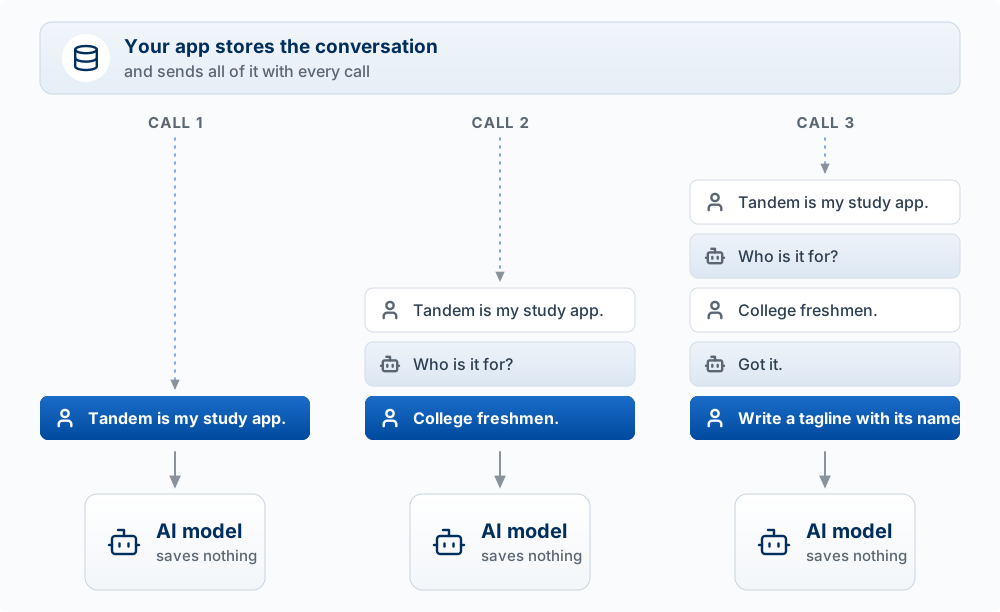
Three predictions follow. A long conversation gets slower and more expensive with each turn, because every turn resends everything. When the window fills, something has to be dropped or summarized, and what was dropped is gone. And an agent that “forgot” your instruction usually no longer had it in its window.
Analogy: the context window is a whiteboard in a room with a brilliant expert who has no long-term memory of you. They can use anything on the board. When you leave, the board is erased. Where it breaks: an expert would remember general things about you; the model remembers nothing, and a human reads the whole board equally, while the model’s attention is uneven.
In a fresh chat, tell the model a made-up fact (“My product is called Tandem and it costs $4 a month”). Ask about it two turns later: it answers correctly. Now open a new chat and ask again. Explain, in terms of what was in the context window, why the second answer fails.
The model writes; the harness acts
A model only produces text. Everything it appears to do (search the web, edit a file, send an email) is software around it that reads that text and runs something. That software is the harness. When Claude Code edits your file, the model wrote a structured request such as “use the Edit tool on page.tsx with this change”; Claude Code checked its permissions, ran the edit, and sent the result back to the model as more text. The same model with a different harness can do different things, which is the point of the agent pyramid in Chapter 1.
This one fact explains a lot. An agent’s capabilities and risks come from the tools the harness exposes; the model alone only writes text. Permissions and hooks (Chapter 1) work because they live in the harness, where the model’s output cannot override them. And when the model’s text can trigger an action, anyone who can put text in front of the model can try to steer that action. Chapter 11 builds this loop into a product and covers the defenses.
The jagged frontier
Models are superhuman at some tasks and fail at nearby tasks that look no harder. You find out which is which by testing your task; the model’s reputation will not tell you. Ethan Mollick and colleagues named this the jagged technological frontier in a field experiment with 758 Boston Consulting Group consultants (Dell’Acqua et al. 2023). On tasks inside the frontier, consultants using GPT-4 finished more tasks, faster, at higher quality. On one task designed to sit just outside it, consultants who solved it without AI were right about 84 percent of the time; those using AI were right roughly 60 to 70 percent of the time. Many took the model’s plausible but wrong analysis at face value. Mollick’s Centaurs and Cyborgs on the Jagged Frontier is the short readable version.
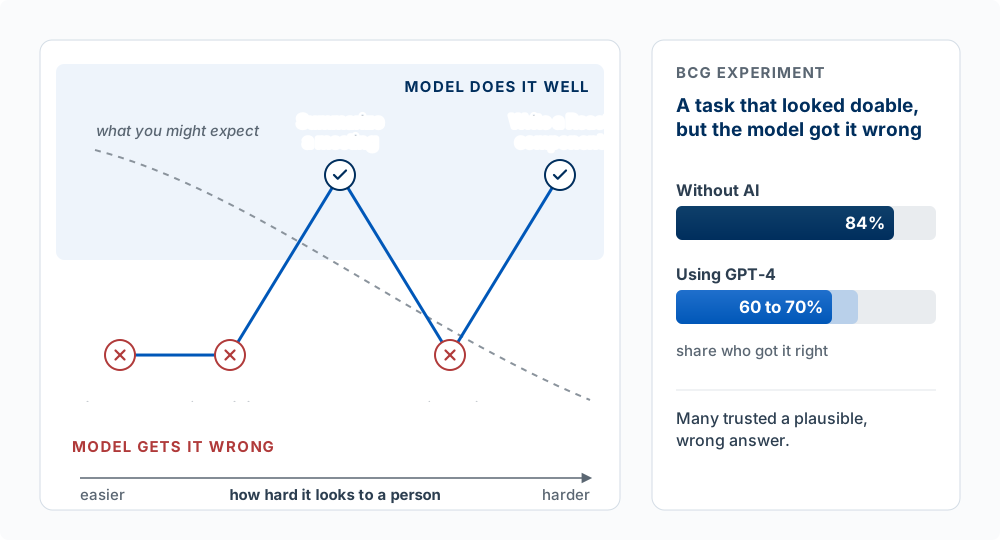
Jaggedness follows from how the model is built. A model is strong where its training text was rich and the task matches patterns it saw (writing a React component, summarizing a meeting). It is weak where the task needs something the mechanism lacks: exact counting over tokens, long arithmetic across a table, a fact past its cutoff, or knowing which of two plausible answers is true. The edge also moves with every model release, so a failure you saw last term may be gone, and a new one may appear.
Pick the one AI task at the heart of your product. Write five realistic inputs, including one awkward edge case. Predict which ones the model will get right, then run them. Where your prediction was wrong, you found the frontier for your product. This is the start of the eval set in Chapter 11: a fixed list of test inputs, each with the answer it should get, that you rerun after every change.
Prompting
Prompting follows directly from next-token prediction: a prompt is the start of a text, and you are shaping it so that the most plausible continuation is the output you want. Background narrows what is plausible. A role sets which kind of text it resembles. Examples show the pattern to continue. A template lets your code fill in live data. Prompts come in a few common types:
| Prompt Type | What it is | Example | Best for |
|---|---|---|---|
| Single-Turn Prompt | A one-off instruction or question sent to the model. | Summarize this article in three bullet points. | Quick tasks where context isn’t needed beyond the immediate request. |
| Role-Based Prompt | Sets a clear role or persona for the AI to adopt. | You are an experienced product manager. Draft a launch plan for a new mobile app. | When tone, perspective, or expertise level matters. |
| Context + Instruction Prompt | Combines background information with a direct request. | Background: Our company sells eco-friendly cleaning products online. Task: Write a short ad targeting parents concerned about chemical safety. | When the model needs background to produce relevant results. |
| Few-Shot Prompt | Includes examples of desired input-output pairs to guide the model’s style or format. | Q: What is the capital of France? A: Paris Q: What is the capital of Germany? A: Berlin Q: What is the capital of Italy? A: |
Showing the model your preferred style or pattern without fine-tuning. |
| Multi-Turn Conversation | A back-and-forth exchange where previous messages build context. | User: Give me a list of U.S. national parks in the West. AI: [List] User: Now sort them by size. |
Complex tasks where you refine or expand the request over time. The whole history is resent each turn. |
| Dynamic, Variable-Injected Prompt | A template where parts of the prompt are filled in with live or changing data. | Write a {tone} introduction to {topic} for someone named {name}. | Automation, personalization, and programmatic API workflows. |
The last row is how prompts work inside a product: your code builds the prompt from a template and data, sends it to the API, and handles what comes back. Chapter 11 shows how.
Under the Hood: The Math
Everything above works without equations. If you want to see the arithmetic that “adjusts the numbers” actually means, the callouts below walk from the simplest model, a straight line, to a small neural network. A language model is the same idea at enormous scale.
In supervised learning, a model learns a mapping from inputs to outputs using examples where the right output (the label) is known. Pretraining an LLM is the self-supervised version: each next word is its own label.
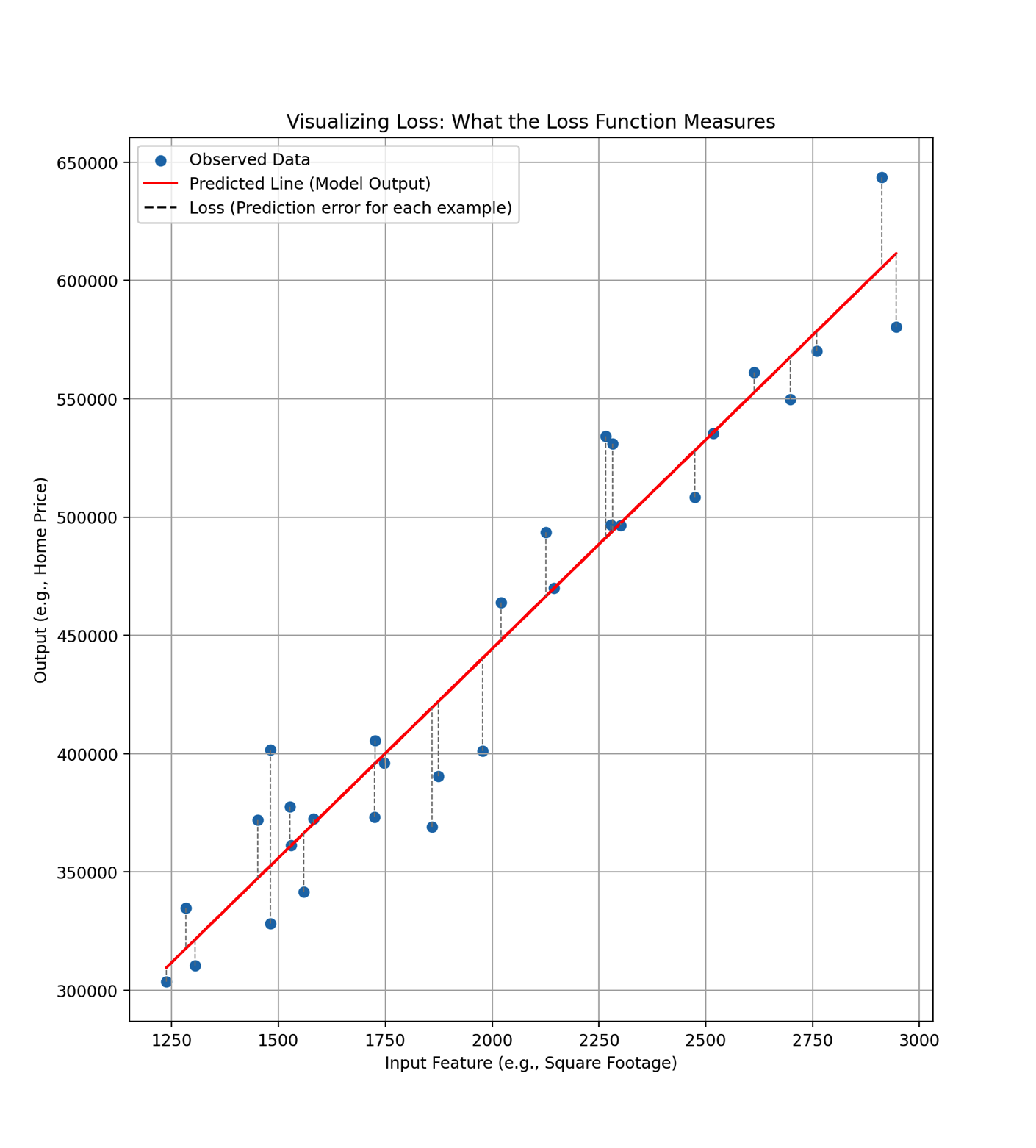
The simplest case is simple linear regression, which predicts one output from one input with a straight line. To predict a home’s value from its square footage \(x\):
\[ \hat{y} = w_0 + w_1 x \]
Here \(\hat{y}\) (y-hat) is the predicted value. \(w_0\) and \(w_1\) are the model’s parameters or weights, the numbers training learns from many examples of real homes.
In the image below, the red line is the fitted model and the dotted lines show how far each prediction is from the real value. Training tries different values of the parameters to make those errors small. The formula for the error is the loss function (here it could be \(|predicted - actual|\)), and the procedure that searches for the best weights is gradient descent.
Gradient descent, by analogy. Picture a hillside whose height at each spot is the total prediction error, and your position is the current set of weights. You want the valley floor. The gradient (the multivariable version of a derivative) tells you which direction is steepest downhill. You take a small step that way, recompute, and repeat until the ground is flat. Training an LLM is this same walk, over billions of weights instead of two. Where the analogy breaks: a real loss surface has billions of dimensions and no single valley, and training stops at a good-enough low point rather than the lowest one.
A straight line cannot capture language. A neural network is a more flexible function built from many small regression-like units.
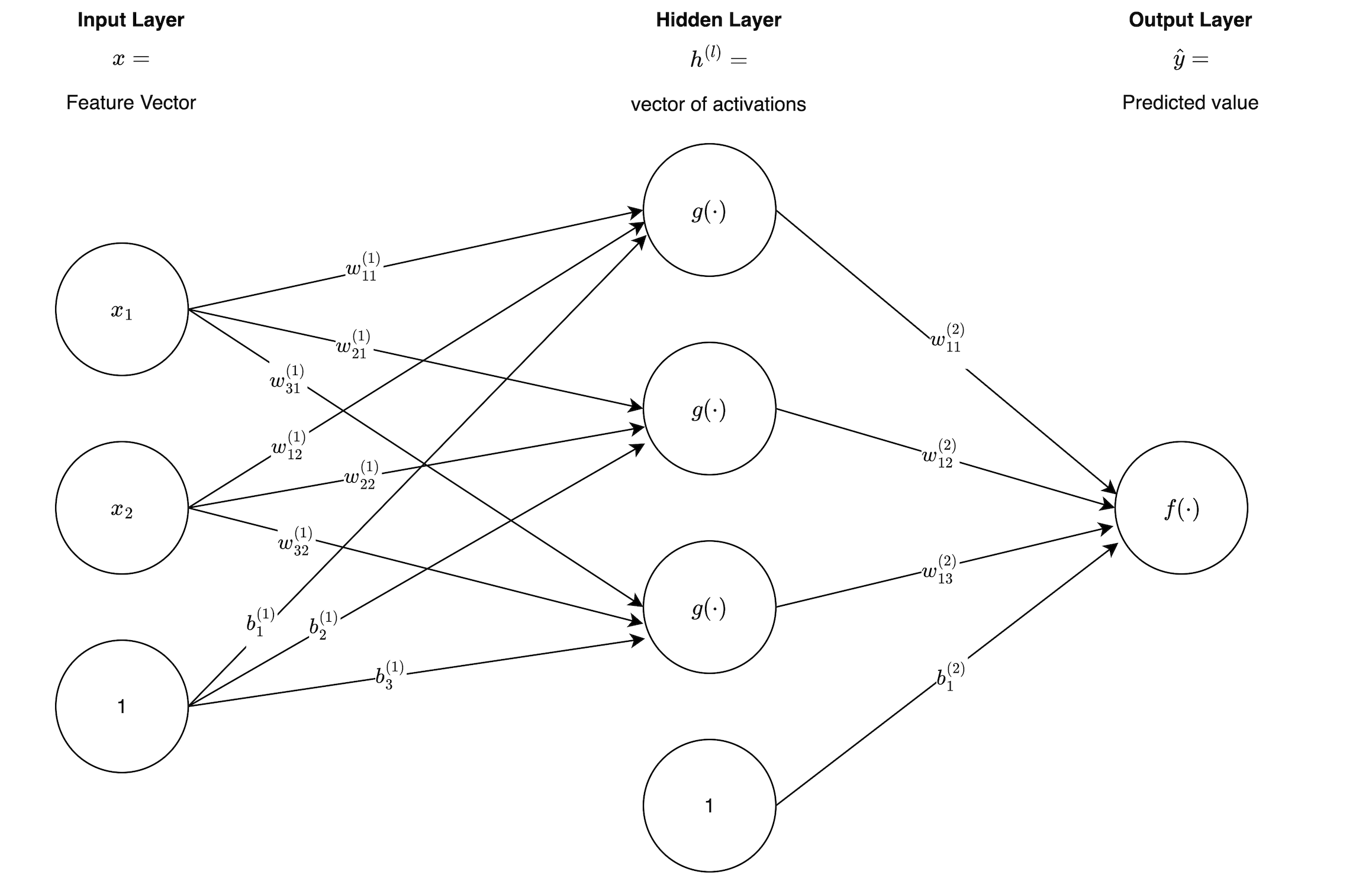
The input layer holds the features, such as square footage and number of bedrooms, plus a bias input fixed at 1. Each circle is a neuron and each line (an edge) carries a weight the model learns. Each neuron in the hidden layer computes a weighted sum of its inputs, adds its bias, and applies an activation function \(g\) that bends straight lines into curves (so the first 500 square feet can add more value than the next 500). Without \(g\), the network would collapse back into plain linear regression. The output layer combines the hidden values with new weights and applies a final function \(f\) that puts the prediction in the right form: a dollar amount, or a probability between 0 and 1.
Simple linear regression has 2 parameters; this small network has 13. GPT-3 had 175 billion, and current frontier models are larger. The principle is identical: each parameter is a weight or bias, and training adjusts all of them by gradient descent. The difference is scale.
In compact form, the network in the picture is a function nested inside a function:
\[ \hat{y} = f\!\big(W^{(2)}\, g(W^{(1)} x + b^{(1)}) + b^{(2)}\big) \]
where \(x\) is the vector of inputs, the \(W\)s are matrices holding the edge weights, the \(b\)s are the biases, and \(g\) and \(f\) are activation functions. Common choices are \(g(z) = \max(0, z)\) (ReLU) and \(f(z) = 1/(1 + e^{-z})\) (the sigmoid, for a probability). A transformer is many such layers, with attention between them.
Key Concepts
- Machine learning and deep learning: machine learning is the part of AI where a computer learns from examples of inputs paired with outputs instead of following written rules; deep learning uses large neural networks. LLMs are deep learning models trained on text.
- Token: a piece of text with an ID number from a fixed vocabulary, about three quarters of an English word. The unit of cost, speed, and every limit.
- Embedding: a list of numbers that places a token (or a whole document) on a map of meaning, so similar meanings sit close together. It also powers search by meaning, as in RAG.
- Attention and the transformer: attention lets each token draw on every earlier token, so its numbers reflect its context; a transformer stacks attention in repeated blocks. Attention runs over the whole context, so a longer prompt costs more and takes longer.
- Next-token prediction: the model scores every possible next token, turns the scores into probabilities, picks one, appends it, and runs again until it stops.
- Sampling and temperature: the pick is a weighted draw, so the same input can give different output; temperature sets how random the draw is. Design on the assumption that output varies.
- Pretraining: self-supervised training on huge amounts of text, where each next token is its own label. It sets the parameters (weights) and gives knowledge up to a training cutoff; no person checked whether the text was true.
- Base model: the result of pretraining. It completes text and can follow a few examples in the prompt (few-shot learning), but it is not yet an assistant.
- Instruction tuning and RLHF: later training on example conversations and on people’s preferences between answers, which turns a text completer into an assistant. It changes behavior far more than knowledge.
- Sycophancy: because people rate agreement a little higher than correction, the model learns to agree. Ask for the case against, and judge disagreement on the evidence.
- Hallucination: fluent, confident output that is false. The model produces the most plausible continuation, and nothing inside it checks whether plausible is true, so anything that matters gets checked against a source.
- Context window: the model’s working memory, counted in tokens. The model is stateless: nothing carries between calls unless the app sends it again.
- Harness: the software around a model that reads its text and takes actions. The model only writes text; capabilities, risks, permissions, and hooks live in the harness.
- Jagged frontier: models are strong at some tasks and fail at nearby tasks that look no harder, and the edge moves with each release. Test your own task.
- Prompting: a prompt is the start of a text, shaped so the most plausible continuation is the output you want, with background, a role, examples, or a template filled with live data.
- Parameters, loss, gradient descent: the numbers a model learns, the measure of its error, and the procedure that adjusts every parameter a small step to lower the error.