
Going to Market
Why This Matters
Shipping is not launching. A deployed product with no users has not launched, and most student products stop there, often because nobody was ever told about them. This chapter is how the first people find out, why they would pick you over what they do today, and what you charge them without losing money on every heavy user.
Go-to-market (GTM) answers four questions, in order:
- Who is it for, narrowly enough that you can find them? (Customer and beachhead)
- Why would they pick you over what they already do? (Positioning)
- How will the first ones hear about it? (First users by hand, then channels)
- What will you charge, and does the arithmetic hold? (Pricing and AI margins)
What makes them stay, and how you know, is the measurement chapter, Measuring What Matters.
Two beliefs to drop before you start. “If we build it, they will come”: they will not, because nobody is waiting for your product, so you go find them. “We just need to go viral”: virality is an outcome of a product people want plus a way for it to spread, never a plan. And GTM is not an afterthought: knowing who you are for should shape what you build.
QuizMe turns a student’s own lecture notes into a practice quiz. The student uploads notes, an AI model writes questions from them, and the student takes the quiz to find out what they do not know yet. It costs $4 a month. Chapters 12 to 15 follow it from launch to the final demo: who it is for, what it costs to run, how to tell whether it works, and how to present it. The example is invented for teaching.
Who It Is For: The Beachhead
The model: pick the narrowest group you can reach by hand and win completely, then widen. A specific group is one you can find, speak to, and build for. A vague one (“college students”) is none of those.
Your Ideal Customer Profile (ICP) is a description of the customer who gets the most value and is easiest to reach. You already did most of this work in Finding and Validating the Problem: the job they are hiring a product to do, and the interviews that showed you the pain. The ICP summarizes that in a form you can act on. The table gives one B2C example (business to consumer: you sell to individual people) and one B2B example (business to business: you sell to companies):
| Block | B2C example | B2B example |
|---|---|---|
| Who | BYU students in a large intro course with a weekly quiz | Office managers at 5-to-20-person dental practices |
| Situation | The night before a quiz, with a stack of lecture notes | Monday morning, rebooking cancelled appointments |
| Current habit | Rereading notes; a group chat swapping old quizzes | A paper list and phone calls |
| Where they gather | The course’s Slack or GroupMe, a study room, a club | A regional association, a Facebook group |
| What they pay for today | A tutor before the final; printed study guides | A receptionist’s overtime |
Geoffrey Moore’s Crossing the Chasm argues you should win a single narrow segment completely before you expand, a beachhead: a small market you can dominate, become the obvious choice for, and use as a base to move outward. For you, the beachhead might be one dorm, one club, one section of one course, one type of small business in Provo. Win that segment first. Ten people who love a product are worth more than a thousand who are indifferent to it.
The beachhead and the technology adoption lifecycle are from Geoffrey Moore, Crossing the Chasm (1991) (Moore 1991).
A useful exercise is defining who your product is not for. This helps you avoid wasting time and money on the wrong audience. For example, if you’re building a no-code tool for small businesses, enterprise CTOs are probably not your customer, even if they express interest.
Write your beachhead as one sentence with a place in it: “students in ___ who , reachable through .” If you cannot name the place where twenty of them gather, your segment is still too vague. Narrow it until you can.
Positioning & Messaging
The model: positioning is why a specific person picks you over their current habit, said in their own words. The real alternative is rarely a competitor’s app. It is usually a spreadsheet, a group text, a sticky note, or doing nothing.
April Dunford’s Obviously Awesome breaks positioning into building blocks, and the order matters because each one depends on the one before:
| Block | Question | Comes from |
|---|---|---|
| Competitive alternatives | What would they do if you did not exist? | Interviews: what they did last time |
| Unique attributes | What can you do that the alternative cannot? | Your product |
| Value | What does that attribute get them? | Their words about the pain |
| Who cares most | Which people value that the most? | The interviews where they showed the most interest |
| Market category | What frame makes your value obvious? | The alternative they compare you to |
You start from the alternative, because “better” only means something relative to what they do now. If you start from your features, you end up describing your product to yourself.
Worked example. Take QuizMe, the example introduced at the start of this chapter. A weak position, written by the founder: “AI-powered adaptive learning platform.” A stronger one starts from three interview quotes:
“I just reread my notes and hope it sticks.” “Someone posts last year’s quiz in the group chat, but it’s never the same questions.” “I don’t know what I don’t know until the quiz.”
The alternative is rereading plus the group chat. The unique attribute is questions built from your notes for this week. The value, in their words: find out what you don’t know before the quiz does. Who cares most: students in courses with frequent quizzes. That gives you a headline nobody had to invent: “Find out what you don’t know before the quiz does.”
The positioning statement
Once the blocks are filled in, a one-line statement gives everyone, including your coding agent, the same description to work from. This template is Geoffrey Moore’s, and chapter 04 uses it for your value proposition (Moore 1991); see Your Value Proposition:
For [target customer] who [pain point], [product name] is a [category] that [key benefit]. Unlike [alternatives], we [unique differentiator].
For students in quiz-heavy courses who reread their notes and hope, QuizMe is a practice-quiz tool that shows you what you don’t know yet. Unlike rereading or last year’s quiz from the group chat, it writes questions from this week’s notes.
The statement is an internal reference that informs all of your messaging; your tagline and homepage copy come from it.
Messages that convert
Messaging is the words you use to deliver the position. Speak to the pain, in the customer’s words, and run the “So what?” test: for every sentence, ask “So what?” If you cannot answer with a customer benefit, rewrite it.
- “We use AI to generate questions from your notes.” So what?
- “So you get questions about exactly what was covered this week.” So what?
- “So you find the gaps tonight, while you can still fix them.”
The last line is the message. The first is a feature description.
What AI can and cannot do for your messaging
A model is a fast drafting partner. It can write twenty headline variations from your positioning statement in seconds, and it can rewrite a jargon-heavy sentence in plain words:
“Write five different homepage headlines for a practice-quiz tool for students in quiz-heavy courses. Use the phrases from these three interview quotes: [paste].”
“Explain how QuizMe builds questions in one sentence that a first-year student would understand.”
What it cannot do is tell you which headline your customers will respond to. You can ask a model “which of these two resonates more with a stressed student?”, and that is a gut check with a model: a guess based on the text it was trained on. It is not an A/B test. An A/B test shows two versions to real people, assigned at random, and counts what they do (see Cause Versus Coincidence). The model has never met your customers. The interview quotes are the ground truth; the model only helps you phrase them.
Pull three quotes from your own interview notes. Fill in Dunford’s five blocks, starting with the competitive alternative. Then write one headline that uses the customer’s words, not yours. If the alternative you wrote is a competitor’s app, check your notes: is that really what the last person you interviewed did?
Pricing and AI Margins
The model: price on the value delivered, and check the floor: every AI call costs you money, so a heavy user on a flat price can cost more than they pay.
A price sits between a ceiling and a floor, with the alternatives as a reference point:
| Level | What sets it | Where you learn it |
|---|---|---|
| Ceiling: value | What the problem costs the customer today, in money and hours | Chapter 04’s workaround spend |
| Reference: alternatives | What they pay now for the workaround or a substitute | Interviews, the substitute’s price page |
| Floor: your cost to serve | Model calls, hosting, payment fees, per user per month | Chapter 11’s arithmetic, your logs |
Three classic approaches each start from one of these. Cost-plus adds a margin to your cost (simple, but ignores what the customer would pay). Competitive prices relative to alternatives (useful when customers already have a clear reference price). Value-based prices from what the problem is worth to the customer: if you save a business $10,000 a year, $2,000 a year is easy to say yes to. Start from value when you can, and check it against the floor.
How not to find the ceiling. Do not ask customers “what would you pay?” and price in the middle of their answers. Chapter 04 warns against exactly this: people invent a number for a hypothetical. Instead, add up what the problem already costs them, the workaround they pay for, the hours lost, the substitute they buy (see “Harden your evidence” in Willingness to Pay). The strongest evidence of all is someone paying: a preorder, a paid pilot, a deposit.
Every AI call is a cost
Chapter 11 showed you how to price one model call (What It Costs). Pricing is where that arithmetic becomes a business decision. The building blocks:
- Cost per core action = input tokens x input price + output tokens x output price. The core action is the one thing a user does that triggers a model call, such as generating one quiz.
- Actions per user per month, which varies enormously between a light and a heavy user.
- Cost per user per month = cost per action x actions per month.
- Gross margin per user = price minus cost to serve, divided by price.
Worked example. QuizMe sends about 4,000 tokens of notes and instructions and gets back about 1,000 tokens of questions. At illustrative prices of $2 per million input tokens and $10 per million output tokens (check Anthropic’s pricing page for current rates):
| Calculation | Result | |
|---|---|---|
| Cost per quiz | 4,000 x $2/1M + 1,000 x $10/1M | $0.018 |
| Typical user, 15 quizzes a month | 15 x $0.018 | $0.27 |
| Heavy user in finals week, 10 a day for 30 days | 300 x $0.018 | $5.40 |
| Flat price | $4.00 a month |
The typical user is very profitable. The heavy user costs $1.40 more than they pay, before hosting and payment fees. With traditional software, a heavy user costs you almost nothing extra; with an AI product, your best users can be your most expensive. The fixes are product decisions: a monthly quiz allowance with paid top-ups, usage-based pricing, caching the repeated instructions (chapter 11), or a cheaper model for the parts where measurement shows it is good enough.
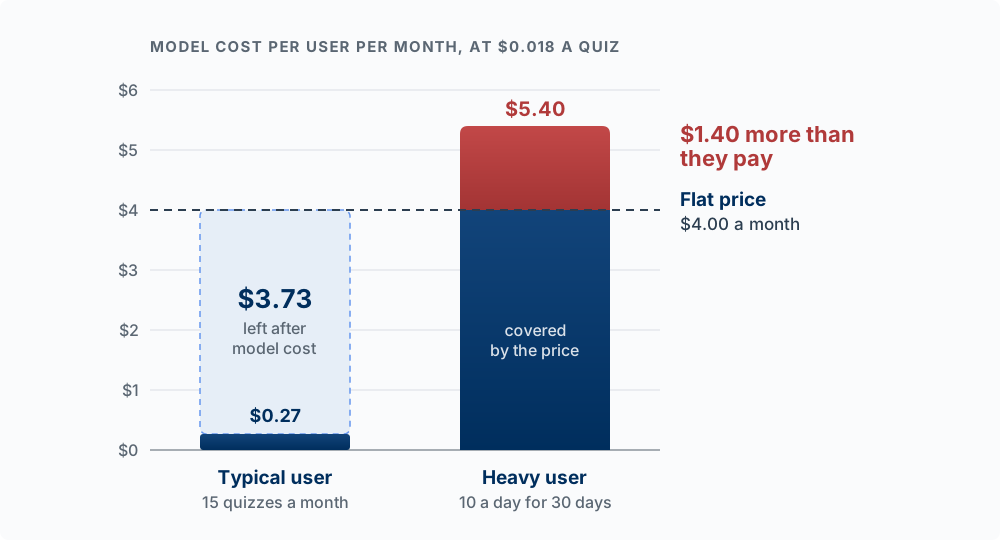
Flat subscription versus usage pricing. A flat subscription is simple to buy and predictable for the customer, and it carries the heavy-user risk. Usage pricing (credits, per-action, tiers with allowances) tracks your cost but makes the customer think about every click. Many AI products combine them: a flat price that includes an allowance.
Should you offer a free tier?
A free tier makes sense when a free user costs you little and either some of them convert or they bring other users. For an AI product, every free user runs up model cost, so a free tier needs a usage cap. At student scale, a free tier is often a distraction from the question that matters: will anyone pay? A few people paying a small amount teaches you more than many people using it free.
For your own product: estimate the tokens in and out of your core AI call, look up current prices on Anthropic’s pricing page (linked in Chapter 11’s What It Costs), and compute cost per action. Then estimate actions per month for your lightest and your heaviest realistic user. At your intended price, which users lose you money? Predict first, then check one real call’s usage numbers in your logs. What is one product change that would keep the heavy user profitable?
Your First Users, by Hand
The model: your first users come from places you can reach yourself. Do things that do not scale, because recruiting people one at a time is how you learn what will scale.
Paul Graham’s essay Do Things That Don’t Scale makes the case: founders hesitate to recruit users manually because it seems small and slow, and that is exactly what works at the start. His examples include the Airbnb founders going door to door in New York to recruit hosts and improve their listings, and the Stripe founders setting up new users on the spot instead of sending a link (Graham 2013). Each conversation teaches you what makes someone say yes, which words work, and where people get stuck. Those lessons are what you later build into a channel.
A concrete target for a two-week sprint: 20 named people contacted, 5 actually using it. Write the names down. Track who replied, who tried it, who came back.
Where the first twenty come from
1. Personal network. Friends, classmates, roommates, professors, LinkedIn connections. Message them with a question instead of a pitch:
“Hey [Name], I’m working on [product] for [customer type]. Do you know anyone who struggles with [pain point]? I’d love 15 minutes to show them what I’m building.”
2. Where your beachhead gathers. The course Slack, the club GroupMe, the dorm floor, the subreddit. Be helpful first: answer questions, share what you have learned. Mention the product when it is relevant.
3. Direct messages. A short, specific note to someone who fits the ICP:
“Hi [Name], saw your post about [topic]. I’m building something for [customer type] and would love your feedback if you have 10 minutes.”
4. Cold email, for B2B, where the buyer is reachable by name:
Subject: Quick question about [pain point] Hi [Name], I noticed you [relevant observation]. I’m building [product] to help [customer type] with [pain point]. Would you be open to a 15-minute demo? [Your name]
Then sit with them while they use it. Watching five people try it teaches more than a launch post to five hundred.
The pitch conversation
You have someone on a call. A sales demo is a conversation built around their problem. (It is a different thing from the final demo in chapter 15, which is a recorded story for an audience.) A 15-minute structure:
- Open (1 min): “Thanks for joining. I want to show you [product], but first, tell me about how you currently handle [pain point]?”
- Listen and adapt (3 min): Let them talk. Take notes. Adjust your demo to their specific pain.
- Show the moment it works (7 min): Walk through the product on their use case, straight to the point where they see the value.
- Handle objections (2 min): Address questions and concerns directly.
- Ask for a commitment (2 min): “Does this solve [pain]? Want to try it for a week?”
Common objections and how to handle them:
- “It’s too expensive.” → “What’s it worth to you to solve [pain]? How much time/money are you losing now?”
- “I need to think about it.” → “Totally fair. What specifically do you need to think through? Maybe I can help.”
- “We’re already using [competitor].” → “Got it. What’s working? What’s not? Here’s how we’re different…”
Six principles of persuasion
People rarely decide on logic alone. Robert Cialdini’s research names six principles that influence decisions, worth using honestly, and worth recognizing when they are used on you:
- Social proof: people do what similar people do. Show that others like them already use and trust you.
- Authority: credible expertise persuades. Signal what makes you credible on this problem.
- Scarcity: limited access or time raises perceived value: early access, a waitlist, a cohort.
- Reciprocity: give first (a useful tool, real help), and people are inclined to give back.
- Commitment and consistency: a small yes leads to a bigger one. Start with a small, easy ask.
- Liking: people say yes to those they like and who are like them. Be human, specific, and warm.
These make a true offer more persuasive; they cannot substitute for one. Used to push a product that does not deliver, they become manipulation, the line drawn in Product Morality.
The six principles of persuasion are from Robert Cialdini, Influence (1984) (Cialdini 1984).
Write the list: twenty names, each with where you will reach them and the one-line message you will send. Before you send anything, predict how many will reply and how many will try it. After a week, compare. The gap between your prediction and the result is information about your message or your segment.
Choosing Your Channel Strategy
The model: a channel is a repeatable path by which strangers become users. Hand recruiting does not repeat; a channel does. Pick one or two that match where your customer already is, and give each a fair test before you add another.
Gabriel Weinberg and Justin Mares’s Traction lists nineteen channels and makes the point that most products grow through one or two of them (Weinberg and Mares 2015). Three questions narrow the choice:
- Where does your customer already spend time? Students: course and club group chats, campus events, Instagram, Reddit. Small businesses: associations, local groups, LinkedIn. Developers: GitHub, Hacker News, dev communities.
- What does it cost, in money and in time to results? You have little money and a two-week sprint.
- Does the product sell itself? If people can sign up and reach value on their own in minutes, a product-led channel fits. If it needs setup or training, a person has to sell it.
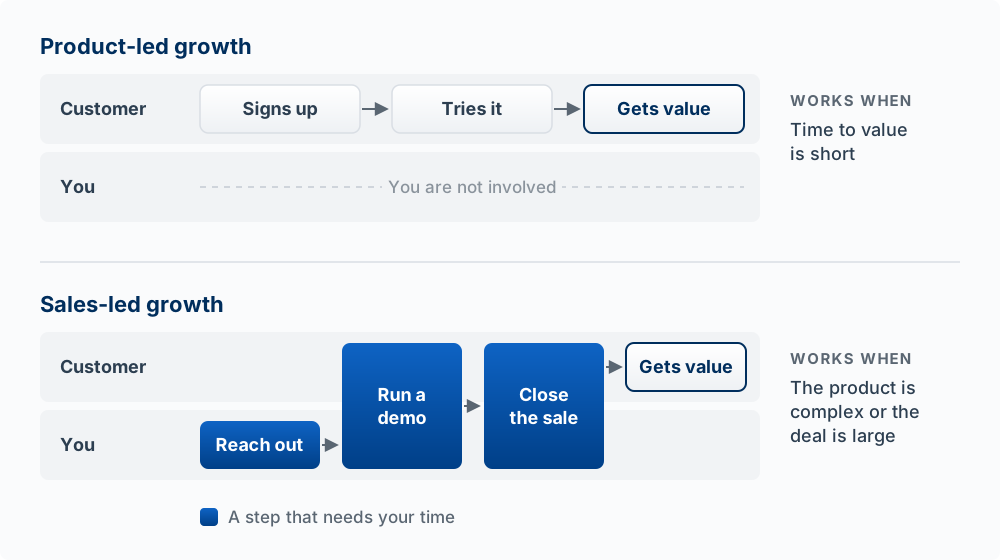
Product-led growth (PLG): users sign up, try, and get value without talking to anyone. Think Notion, Figma, or Slack. It works when time-to-value is short and the “aha moment” happens on its own. Sales-led growth (SLG): you reach out, run demos, and close through conversation, as with Salesforce. It works when the product is complex, the deal is large, or the buyer needs to learn a new category. Many companies start product-led and add sales as they move to larger customers; Notion started self-serve and now has enterprise sales.
| Channel | Fits a student sprint? | Note |
|---|---|---|
| Community and word of mouth | Yes | Be useful where your beachhead gathers |
| Direct outreach (DMs, email) | Yes | The hand-recruiting above, made routine |
| Building in public (LinkedIn, X) | Partly | Results take months; useful for credibility |
| Content and SEO (search engine optimization: showing up in search results) | Rarely | Results usually take months |
| Partnerships | Sometimes | A club, a TA, a professor who shares it with a class |
| Paid ads | Rarely | Costs money to test, and needs validated messaging first |
The biggest mistake is trying every channel at once. Pick 1-2, commit for a fixed period, and measure results. If it’s not working, stop it and try something else. Test one or two channels thoroughly.
A second audience: the models
Inbound (customers who find you on their own, instead of you reaching out to them) now has a second audience. A growing share of buyers ask a model rather than a search engine, which means you also care about which sources those models cite. A Semrush study of 150,000 citations in June 2025 found the answer skewed heavily toward a handful of community and reference sites.
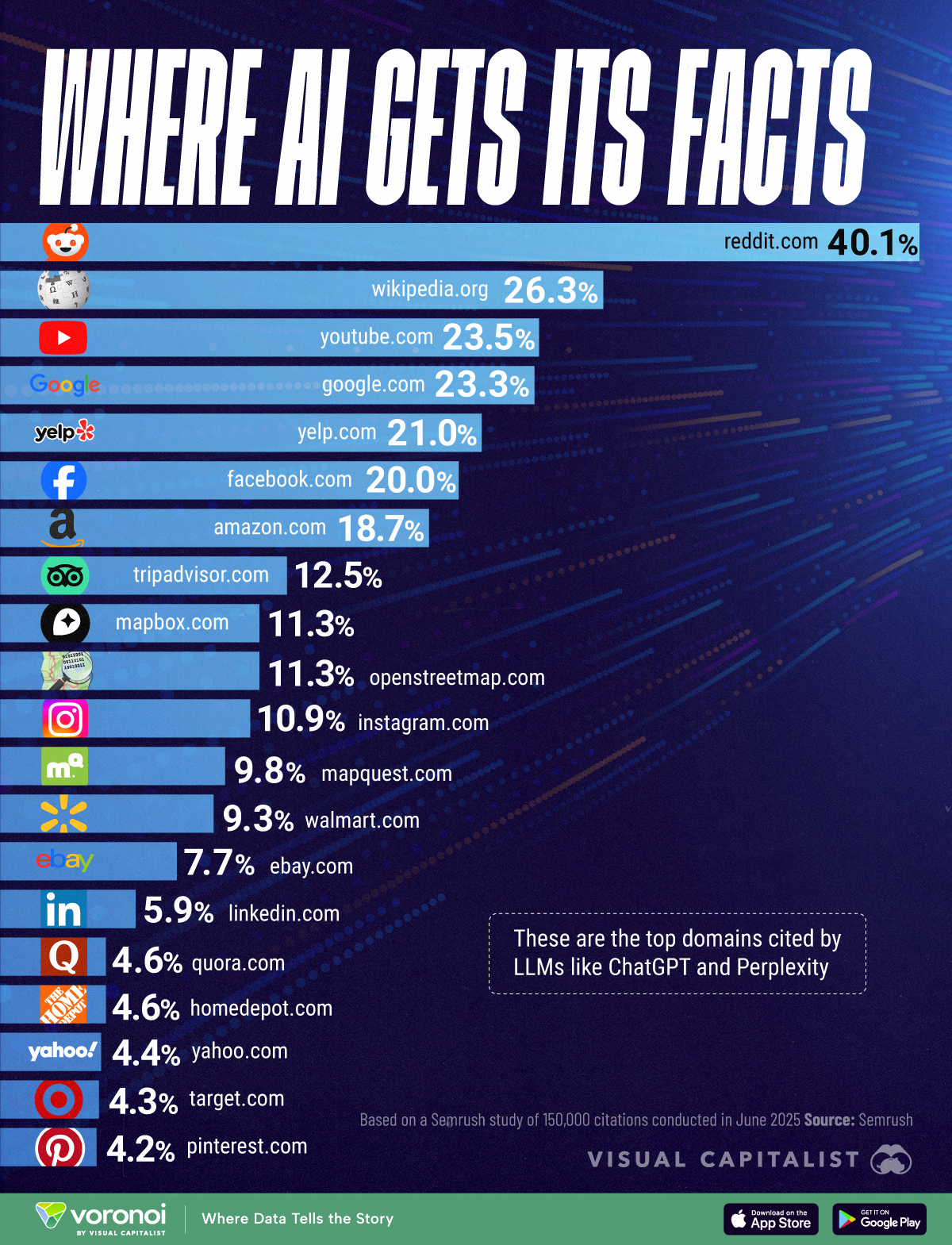
Read that as a channel list. A genuinely helpful answer in the subreddit where your customers already are does two things: it reaches them, and it is the kind of source a model repeats later. The underlying advice is unchanged: be useful in public where your buyers gather. What has changed is where “public” is.
Pick one channel for your next sprint. Write down what you will do, how many people it should bring to your product, and the date you will judge it. If it brings fewer than half that number, what will you try instead?
Launch & Iterate
The model: a launch is the start of an experiment, so it needs a definition of success and working measurement before anyone sees the link.
Instrument it before you launch
Do not ship a landing page without analytics on it. You will get one first wave of traffic and exactly one chance to learn from it, and an uninstrumented launch wastes it. Before you send anyone the link, write down what “working” means (one value metric, a threshold, a few guardrails, a date) and put event tracking on your core task. The how is in Measuring What Matters; do it now, before launch.
Launch in rings
- Private beta: the twenty people you invited by hand. Watch them use it. Fix what breaks and the step where they get stuck.
- Public beta: open it to your beachhead (the course, the club), labeled as a beta.
- Wider launch: a post in the communities you have been helpful in, Product Hunt (a site where new products are posted and voted on), LinkedIn.
Deploy is not release. On Vercel, merging to main puts the code on the live site at once. Launching in rings needs a second switch: a release flag (the feature flag from Chapter 9) that decides who sees a deployed feature. The simplest version is a Supabase table listing which users have which feature. With the flag on only for you, the new code is live and nobody else sees it; turn it on for your twenty beta users, then for everyone, with no new deploy (Figure 20.3). The Agent Team Kit separates three moments: a push runs the checks, a deploy puts the code on the server, and a flag releases it to people (deploy is not release).
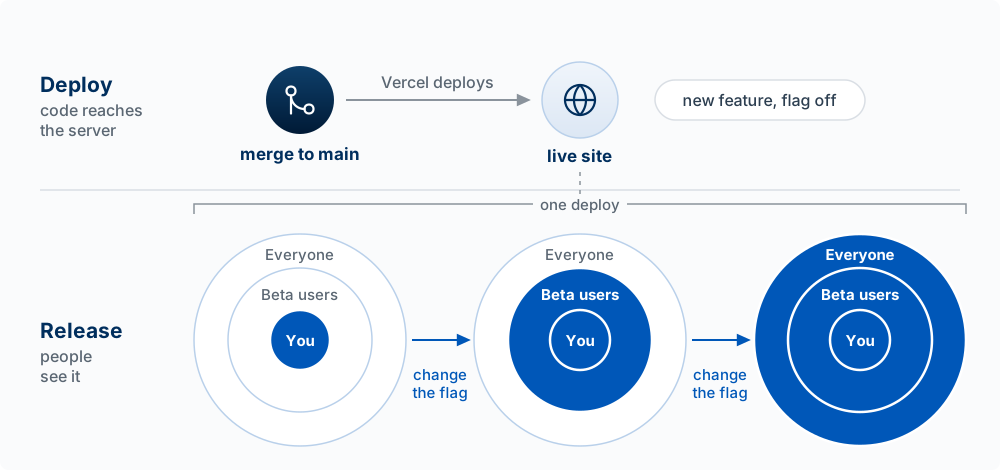
The Agent Team Kit’s release flags spec goes further than a student product needs, but three of its rules apply at any size. Check the flag on the server as well as in the interface: a hidden button over a working endpoint (the server address the button sends its request to) can still be called. Turning a flag off stops new use and undoes nothing already done; an email sent or a payment taken while the beta ring had the feature stays sent and taken (flag or staging is whose data). And remove the flag, with the code path it switched off, once the feature is on for everyone. Chapter 9 compares a flag with a staging environment and says when to use each.
You can launch more than once. A new feature or a major update is a new reason to tell people.
When to change your GTM
Change the plan when the evidence says the plan is wrong:
- People sign up but do not reach first value (an onboarding or product problem, not a channel problem).
- A channel you gave a fair test brings almost no one.
- Interviewees keep describing your product in words different from your messaging.
- Acquiring a customer costs more than they will ever bring in (see Money Metrics).
How: go back to customers and do more interviews, rewrite messaging in their actual words, narrow or shift the ICP, or try the next channel.
Example. You launched a planner for “busy students.” Nobody keeps using it. You look into it and find that your few retained users are student-athletes who use one feature, the travel-week schedule, that you almost cut. Reposition as “the planner for student-athletes on the road” and focus on that audience.
Using AI on launch data
AI is useful here, within limits:
- It can summarize open-ended feedback into themes, if you ask it to quote the responses behind each theme so you can check. It can draft experiment ideas, write the SQL for a funnel or cohort query (Chapter 14 explains both), and check your arithmetic.
- It cannot tell you why signups rose from a list of weekly totals. Paste eight weeks of signup counts into a model and ask for “patterns” and it will find some, because it always produces an answer, and with a few dozen users most week-to-week movement is noise. Whether a change caused a result is a question of how the data was collected, which the model cannot see. See Cause Versus Coincidence.
“Here are 20 user feedback responses: [paste]. Group them into the top 3 themes. For each theme, quote the responses that belong to it, and list any responses that fit no theme.”
Write your launch note before you launch: the date, who will get the link, the one number that means it is working, and the threshold. Commit it. Two weeks later, read it back before you look at the data.
Going Deeper
- Traction by Gabriel Weinberg & Justin Mares (Weinberg and Mares 2015): the 19 channels framework
- Obviously Awesome by April Dunford (Dunford 2019): positioning from the customer’s alternative
- The Mom Test by Rob Fitzpatrick (Fitzpatrick 2013): customer interviews done right
- Paul Graham, “Do Things That Don’t Scale” (Graham 2013)
Key Concepts
- Go-to-market (GTM): four questions in order: who it is for, why they would pick you, how the first ones hear about it, and what you charge.
- Ideal Customer Profile (ICP): a description of the customer who gets the most value and is easiest to reach: who, their situation, their current habit, where they gather, and what they pay for today.
- Beachhead: the narrowest group you can reach by hand and win completely before widening.
- Positioning: why a specific person picks you over their current habit, said in their own words. Dunford’s blocks start from the competitive alternative, then unique attributes, value, who cares most, and market category.
- Competitive alternative: what the customer would do if you did not exist, usually a spreadsheet, a group text, or doing nothing.
- Positioning statement: “For [customer] who [pain], [product] is a [category] that [benefit]. Unlike [alternatives], we [differentiator].” An internal reference that all messaging comes from.
- “So what?” test: ask “So what?” of every sentence of your messaging until the answer is a customer benefit.
- Gut check with a model: a model’s opinion of your copy, a guess based on its training text. Only an A/B test with real people shows which message they respond to.
- Ceiling, reference, floor: a price sits between the value of the problem to the customer and your cost to serve, with what they pay for alternatives as a reference. Find the ceiling from what the problem already costs them, never by asking what they would pay.
- Value-based pricing: price from what the problem is worth to the customer, then check it against your cost to serve.
- Cost per user and gross margin: cost per AI action times actions per month; gross margin is price minus cost to serve, divided by price. On a flat price, a heavy user of an AI product can cost more than they pay.
- Flat vs. usage pricing: a flat subscription is simple and carries the heavy-user risk; usage pricing tracks your cost; many AI products use a flat price with an allowance. A free tier needs a usage cap.
- Do things that don’t scale: recruit the first users by hand, one at a time, to learn what makes people say yes. A sprint target: 20 named people contacted, 5 using it.
- Six principles of persuasion: social proof, authority, scarcity, reciprocity, commitment and consistency, and liking. They make a true offer more persuasive; used to push a product that does not deliver, they become manipulation.
- Channel: a repeatable path by which strangers become users. Pick one or two where your customer already is, and give each a fair test.
- Product-led vs. sales-led: product-led growth lets users sign up and reach value alone; sales-led growth needs a person to reach out, demo, and close, which fits a complex product or a large deal.
- Models as an audience: buyers increasingly ask a model, and models cite community and reference sites, so being useful in public where buyers gather reaches both.
- Instrument before launch: write down what “working” means and track the core task before anyone sees the link.
- Launch in rings: private beta, public beta, then wider launch.
- Deploy is not release: a merge deploys the code; a release flag decides who sees it, so each ring is reached by changing the flag, with no new deploy. Check the flag on the server.
- When to change your GTM: when people sign up but do not reach value, a channel brings almost no one after a fair test, customers describe you in different words, or acquiring a customer costs more than they bring in.
- AI on launch data: a model can group feedback into themes, quoting the responses behind each, and draft queries; it cannot tell you why a number moved.